Jan-Feb 2018 eNews

December 2017 Tutor Mentor eNews

 
Use the ideas and resources shared monthly to help youth in your zip code have opportunities to participate in well-organized, mentor-rich, non-school programs.

January-February 2018 - Issue 166
New Year. Same Old Challenges. Get Informed. Get Others Involved.

Want to know more about Dan Bassill (me) and the goals of the Tutor/Mentor Institute, LLC? Listen tothis podcastinterview.
 
The ideas shared in this monthly newsletter can be used by youth organization leaders, resource providers, political leaders, universities, volunteers and youth to help mentor-rich programs thrive in all of the neighborhoods where they are most needed.

While I try to send this only once a month, I write blog articles weekly. In the sections below I post links to a few of the articles published in the past month. Spend a little time each week reading the articles and following the links. Use in group discussions with people who are concerned about the same issues. Create a blog like this sharing your own ideas.

If the newsletter does not format correctly in your email, or if you want to return to it for future reading or to share with others, use this link http://www.tutormentorconference.org/newsletter.asp

Encourage friends, family, co-workers to sign up to receive this newsletter.Click here.
(If you subscribe, don't forget to respond to the confirmation email)
Local Leadership Needed to Build and Sustain Mentor-Rich Programs in More Places
Maps of Chicago and other places can show where youth need extra help that non-school programs provide. Leaders needed at the program level, the neighborhood level, and the city level.

You can find this graphic in this Tutor/Mentor blog article.
 
Maps of Chicago and other cities show where poverty is most concentrated. These are areas where youth and families need good schools, and where they need great non school tutor, mentor and learning programs.
 
No program starts off great. It takes a few years to build trust, participation, a culture, and a support system. And, it takes 12 years for a first grader to finish high school. The oil well icons on the map above intend to show that great programs are needed in many places, and they need to be there for many years.
 
Each program needs a board of directors and diverse base of volunteers along with community support and a consistent source of funding to become great, then stay great for many years.
 
In 2011 Tutor/Mentor Institute, LLC created a map presentation showing the number of youth age 6-17, in each Chicago community area, who were living below the poverty line. (see pdf) For instance the Austin area had 6356 and the North Lawndale area had 4717. If a non school tutor/mentor program were serving 50-75 kids, it would take quite a few programs just to reach half of the kids in these areas.
 
Thus, while each program needs great leadership and support, neighborhood leadership is also needed to assure there are enough programs to serve as high a percent of the K-12 youth, in a zip code or community area, as possible.
 
At the city level the Mayor should be looking at maps like this, and have a team in place to help grow the number of well-organized programs that are needed in every community area. That means mobilizing public and private dollars and making sure they flow to all programs, not just to a few select groups, or to a few types of program providers.

This is not a new message. It's one that I start every year with and that I support throughout the year with blog articles, social media posts and many one-on-one conversations.

Recommended reading:
* So many problems. Building networks for solutions -read
* Stopping the violence. Invest in the neighborhoods -read
* Black Families Fleeing Chicago; Ending in Segregated Suburbs -read

Read more articles like this onTutor/Mentor Institute, LLC blog.
Making Strong Programs Available in More Places: What's the Plan? What Information Are You Using?
Every youth serving organization competes with the others for the same operating resources. Let's innovate ways to increase the pool so there's more for all the programs that are needed in big cities like Chicago.

You can find this graphic in this article where I ask "What do we need to do to fill every high poverty neighborhood with great non-school tutor, mentor and learning programs"

I've been creating maps and visualizations since 1994 to show where existing non-school tutoring/mentoring programs are located in Chicago and where more are needed...and to show roles leaders can take to draw attention and needed support to programs in every high poverty neighborhood.

Visit this pageto see my most updated list of Chicago area programs.

This graphic shows the number of programs in my list for different sections of the city and suburbs (view article with map). For this information to remain useful, I need help from people in different areas who will help update my information, tell me about new programs, or programs I don't know about, and tell me when programs are no longer operating.

Recommended Reading:

* Expanding social capital for youth living in concentrated poverty -read

* Connecting People and Ideas -click here
* Birth to work blueprints needed -click here
* Reaching out to universities- click here

Nothing happens until someone reads these articles, then invites others to do the same. This is an on-going process, where many can take leadership roles.
What's Your Planning Cycle Look Like?
Building and sustaining a well-organized mentor-rich program is a challenge. Making enough programs available in all areas is an even bigger challenge. Attracting young people and keeping them involved through high school is an even greater challenge.

This concept map can be seen in this article.
 
Where do you get your ideas?
What data do you use to show why your youth organization is needed where it is? What research do you point to? What models do you look at and say "I want to do what they do." How do you show your vision, theory of change, strategy and successes on your web site?

These are all questions that Tutor/Mentor Institute, LLC points to on its web sites and blogs. I don't claim to have the answers. The articles I point to are intended to expand your thinking, so you can innovate solutions that work for you and your community. You just need to spend a little time, on an on-going basis, to browse the sites and know what's there.

For instance, where do you find data indicators? You can see the map below at this link. Under each graphic are links to web sites with rich data and mapping tools.


What other resources can you find on the Tutor/Mentor Institute, LLC web sites? Here's a concept map that shows the four sections of the web library I've been building since the mid 1990s.
 
Visitthis article where I've used Thinglink to highlight what's in each section.

Another way to know what's in the library is to visit this article, where I have a list of links that I point to often in my articles. This points you to each sub section of the web library, my visual PDF presentations and my concept maps.

Find other articles related to starting, sustaining tutor/Mentor programs -click here
 
Here are some resources you'll findin the library .
Understanding Black History, Race and Class in America. Three sections of the web library contain articles related to this topic.

* Black History month -click here
* Poverty, Race and Inequality -click here
* Equal Justice, Poverty Law & Juvenile Justice -click here
 
Here' are some other links of interest that are recent additions to the web library:
* Story map shows life and words of Dr. M.L.King, Jr. -click here
* A Graphic Re-Visioning of NonProfit Overhead -click here
* Who Are The Poor Americans? -click here
* Cook Central - Cook County GIS web portal -click here
* How Poverty Can Follow Children into Adulthood -click here
* Education Can't Solve Poverty. So Why Do We Keep Insisting That It Can -click here
* Understanding issues of rural vs urban America -click here
* Engage students in local-global problem solving -click here


Other links of interest:
* To&Through Project website. Find information showing progress of CPS freshmen to and through 4-year college. Find ways to help.click here

* MENTOR Illinois resources for mentors page -click here

* Indiana Afterschool Network Out-of-School-Time Conference, April 9, 2018 -details

* Chicago Organizations in Intermediary Roles -click here

* See what's being discussed on Twitter - use Tutor/Mentor#hashtag map

*View past Tutor/Mentor Newsletters - use for on-going learning -click here
 
Dan Bassill (that's me) is available to discuss any of these ideas with you, or others, via Skype, Google Hangouts or in person if you're in Chicago.
Wishing you all a Happy, Healthy,
Hopeful and Safe 2018.
Thank you to all who made contributions in 2017 to help me keep the Tutor/Mentor Connection and Tutor/Mentor Institute, LLC ideas and resources available to you and others.
 
Your help is still needed in 2018. Click here to contribute.

Tutor/Mentor Connection,
Tutor/Mentor Institute, LLC
 
Merchandise Mart PO Box 3303, Chicago, Il 60654
This email address is being protected from spambots. You need JavaScript enabled to view it.http://www.tutormentorexchange.net

Copyright © 20XX. All Rights Reserved.

Tutor/Mentor Institute, LLC,MerchandiseMartPOBox3303,Chicago,IL60654

Use Information Resources During Time of Crisis

During the COVID-19 crisis millions of people are restricted to staying at home, making the Internet and TV, along with the telephone, their main means of connection to the larger world. 

During this time the Tutor/Mentor Connection/Institute, LLC's  information-based resource library can be a useful source of information and ideas to help people find their way through these challenging times and to help build and sustain volunteer-based tutor/mentor programs that will still need to be reaching youth in high poverty neighborhoods of Chicago and other cities once this crisis is over. 

Use the resources on this web site to support your learning.  Do a Google search using "tutor mentor" and any of the words in the tag cloud below, and find articles intended to stimulate and influence thinking of leaders across Chicago and the rest of the country.

Click here to view to an interview with Dan Bassill, founder of Tutor/Mentor Connection (1993) and Tutor/Mentor Institute, LLC (2011).

Click here and use the PayPal button to send a contribution to support this work.


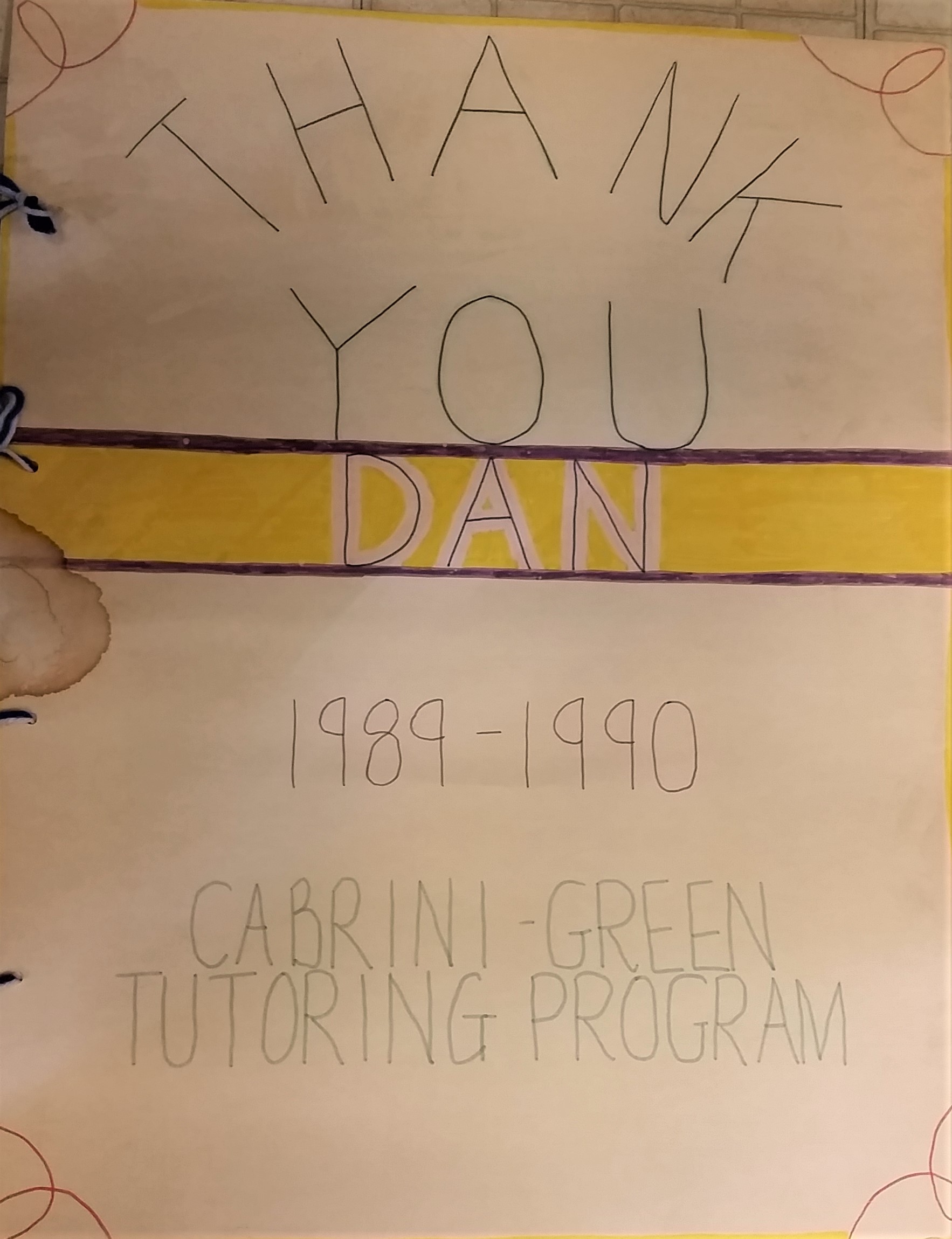
Thank You Dan - 1989-90 card from students & volunteers

Thank you Dan card, from students and volunteers, 1989-90

View here

Learn What's On this Web site

Learn what's on this web site.  View this video to learn what's in each section.

Here's an article that shows what's in each section.

Open and close each section, starting at top left, and going down, then moving to top right, and going down. Get to know what's in each section. Come back often and use these ideas and resources.

See list of illustrated PDF presentations on this web site.

Read the blogs! New Articles Weekly.

I'm Dan Bassill. I encourage you to read these blogs weekly and share them with your networks.  

Tutor/Mentor Blog

Mapping for Justice Blog

Tutor/Mentor Exchange Blog

Intern blog - click here

Listen to Podcast describing Tutor/Mentor Connection (1993-present) and Tutor/Mentor Institute, LLC (2011-present)  - click here

New additions to the library - click here

Navigation of web site

To help you navigate the site, we've numbered sections of the home page on this graphic.

1) this is a progression of steps you should take to better understand issues, build a geographic distribution of resources and programs, involved leadership from all sectors, start new programs where needed, etc.

2) this is a list of links to other web sites we host with additional information

3) these are links to blog articles that connect the information on the web site to current events and attempt to build greater support for tutor/mentor programs in more places

4) the menu bar at the top of the page points to information spread throughout the site, and to visualizations done by interns to help build a better understanding of our strategies

5) this points to a list of Chicago tutor/mentor programs where you can volunteer time or talent; and to pages where you can offer support for helping continue the work being done by Tutor/Mentor Institute, LLC.

6) this section includes history, mission, planning resources, etc.

7-9) The middle section of the web site will be refreshed regularly to focus on some of the ideas contained in the sections along either side of the home page. Once you browse through the site and the links you'll see that this web site provides a wide range of information in many different sections. It may be difficult for first-time visitors to know where to start, or what to look for.

View this video to help you navigate this site,  created by an intern from South Korea and IIT in Chicago

Mapping Network Growth

Know your network. Use your Network.

This graphic is part of an essay that you can read at this link.  It describes a need to share ideas from the Tutor/Mentor Institute, LLC with a growing number of people in Chicago and around the country if we are to achieve long-term success in connecting larger numbers of inner city K-12 youth with adult tutors/mentors through well-organized non-school and school-based tutor/mentor programs.

What is Network Analysis?
If you have not thought much about network analysis, or how networks of people need to work together to solve complex problems, the links below provide a path for your learning.

How does this impact youth?
If you would like to follow our progress in mapping and understanding the Tutor/Mentor Connection network which has grown since 1975 when founder Dan Bassill began his leadership of a volunteer-based tutor/mentor program in Chicago, follow the links below.

Understand Geographic Mapping, Too.
Tutor/Mentor Connection has piloted uses of GIS maps since 1994. See ideas here, here, and here.


Links to follow:
*  Social Network Analysis Workspace for Tutor/Mentor Institute, LLC and Tutor/Mentor Connection - here

*  Read report showing analysis of 1994-2014 Tutor/Mentor Conferences by IVMOOC2015 team at Indiana University. Looking for researchers who will do follow up on this work

* Collaboration and Community building articles - library

* Social Capital articles and research articles - Library

* Articles on Tutor/Mentor Blog. a) Network Building, b) Network Analysis c) Networking

* Social Capital links in Wordpress blog

* Mapping social network using NodeXL - tutorial

* Talent needed to support this work - network map (this could be used as worksheet for any organization)


Work Done to Map Tutor/Mentor Connection Network Growth

* Tutor/Mentor Conference analysis - 2008-2009
* Maps showing Tutor/Mentor Conference participation
* Growth of Ning network from 2007-2012 - Intern project
* Building Networks of Purpose - Network Analysis using Facebook Group . This also is an example of how SNA could demonstrate value of long-term tutor/mentor programs.

New advances in network mapping -
Visit the ICouldBe web site and follow the work they have started to expand social capital and map network growth of their students.

Strategy Presentations by Interns

Between 1993 and 2015 interns from many colleges and universities helped the Cabrini Connections, Tutor/Mentor Connection and Tutor/Mentor Institute, LLC share ideas and strategies by creating visualizations that interpreted ideas they saw on our blogs.  Many were interns from South Korea and China. Most were from IIT in Chicago.  

On this page are some of the visualizations created using Adobe Flash animation, which is no longer supported. These have been embedded into videos so you can still view them.  As you look at these consider ways your own students might interpret the same ideas, but focused on your community, not on Chicago.   

Visit this page to see additional videos and additional visualizations created by interns. View articles on this blog showing work done by interns.

Note. Most of these videos were created prior to 2018 and still show a PO Box mailing address.  Use the contact us page to find current information. 

Article 1 Image
This animated strategy map. View the video version - click here 

This is a second video with this animation. 

View this blog article showing how this project was first created by Alan Yoo and Rack Hyu Shin in January 2009, then updated in the fall by Gun Woong Go and Sung Joong Kim. The narration was provided by Chris Warren, our 2008-09 NUPIP  Fellow.

Article 2 Image
Resources available on the Tutor/Mentor Connection website.    click here

 
This was a second project created in 2009 by Gun Woong Go and Sung Joong Kim. Since flash animation no longer works you can view the animation in the video link shown above.

Article 3 Image
Year-round strategy animation/video - click here

This Flash Animation was created in 2010 by Eunsoo Lee and Jawon Koo, from South Korea. Read about it in this blog article.this blog article.

Article 4 Image

Push-pull strategy visualized in this animation. View video at click here

This blog article shows the original version used to create this animation.

This anArticle 5 Image

Volunteering as a form of adult service learning.  click here

Read this article to see how In Hee Cho, and intern from South Korea, created this animation in 2011.   In this article you can see the first version of this animation, created in 2007 by an intern from Hong Kong. 

Article 6 Image


Volunteer Growth Cycle - view video  click here

This presentation was created in 2010 by Li Li, a University of Michigan graduate student who was part of an Alternative Spring Break Program - click here

Article 7 Image
Enough is Enough animation -   click here

This animation was created by an intern from South Korea in 2011, using this article as a starting point. 

Article 8 Image
How to start a tutor/mentor program - click here

This animation was created by Sam Lee, an intern from South Korea, in 2011.

Article 9 Image
Interns can make a difference.   click here

This Prezi visualization was created by SunJoong Yoo in 2014 to show work done by previous interns.   This type of project could be done in many schools, helping connect people and ideas from past years. 

Article 10 Image
Role of many leaders - animation.  click here   

This was the second part of a Flash Animation project created by Eunsoo Lee and Jawon Koo in 2010.

Article 9 Image
Learning Path to understand and adopt Tutor/Mentor strategies - click here

 This video was created in 2015 by Wona Chang, and intern from South Korea to draw attention to the information in this concept map

Article 12 Image
Growth of the Network - Mina Song, 2012 - click here

Visit this blog article to see network analysis work done in 2012 by Mina Song and Chul Wan Park, interns from South Korea.

Article 13 Image
Getting to Know the Tutor/Mentor Connection, by Song Me Lee, intern from South Korea. 2012- click here


The work done by interns that is shown on this and other pages demonstrates a role that students at any college or high school could take.  Imagine going to your school's website and find a collection of visualizations similar to what I show on these pages. 

Article 14 Image
"We Will be Hope" animation sharing who the Tutor/Mentor Connection is.  By Song Me Lee, 2012
click here
Article 15 Image
PSA created in 2014 to call attention to Shoppers Guide pdf - click here

This is one of four PSA videos created in 2014 by Sun Jong Yoo, an intern from South Korea.  View the Shoppers Guide pdf at this link

Article 16 Image
PSA created in 2014 to call attention to planning strategies shared on Tutor/Mentor blog - click here

This is one of four PSA videos created in 2014 by Sun Jong Yoo, an intern from South Korea.  View the PDF at this link

Support Mentoring Throughout The Year

Help make mentor-rich programs available to youth throughout Chicago and other cities.

Read article titled ROLE OF LEADERS

Read more about National Mentoring Month and ways to get involved.  Follow Tutor/Mentor Institute blog articles and build your involvement.

Become a sponsor of the Tutor/Mentor Institute, LLC and my efforts.

Read my Dec. 2016 Holiday Letter

Daniel F. Bassill, D.H.L.
Tutor/Mentor Connection,  Tutor/Mentor Institute, LLC

Team-Building

The graphic below shows the talents that the Tutor/Mentor Institute, LLC seeks to combine in a team of people and organizations working to help more and better volunteer-based tutor/mentor programs reach kids living in high poverty areas of the world. That's our mission. This is the team we need to build to achieve it.


One section of this graphic focuses on "knowledge management" and includes visualization and social network analysis. Such talents are needed to turn this graphic from a static image, to a concept map such as this, to an interactive platform where people can log in, choose what group they want to be part of, then show up on an updated version of the concept map.

Another role of knowledge management and visualization would be to create debategraphs, like this one, to help organize the ideas we're talking about and show how they connect to each other in an on-going process aimed at building and sustaining our work for many years. In this case, the goal is not just to sustain Tutor/Mentor Institute, but to help sustain hundreds, if not thousands, of individual tutor/mentor programs operating in multiple cities.

If we can create these tools and apply them to our own team building, we can share them to help with team-building in any tutor/mentor program, any intermediary network, and any social benefit cause. If we can earn income from leasing these or training people to use them we can sustain our efforts without dependence on government or philanthropic support.

If you want to be part of this team introduce yourself on the T/MC Forum or email This email address is being protected from spambots. You need JavaScript enabled to view it.