• Home
  • Calendar
  • Contact us
  • Video
  • Slide News
  • Library
  • Newsletters
  • Getting Started
  • T/MC Strategy MAP
  • Strategy Presentations
  • Concept Maps
  • For Phone Viewers
tutormentorexchange.net
  1. You are here:  
  2. Home
  3. Uncategorised

Tutor/Mentor Institute

  • Tutor/Mentor Learning Network
  • Understanding issues and benefits of programs
    • Defining Terms
    • Strategy Visualizations by interns
  • Distribution of Tutor/Mentor Programs
  • Leadership Strategies
  • Business involvement
  • Collaboration & Capacity Building
  • Planing Strategies
  • How to Start a Program
  • Conferences and OnLine Forums
    • Previous Conferences
    • Conference maps
  • Volunteer Recruitment
    • Volunteer recruitment
  • Newsletter
  • Sign Up for eMail Newsletter
  • 2025 T/MI newsletters
    • December 2025 T/MI News
    • November 2025 T/MI News
    • October 2025 T/MI News
    • September 2025 eNews
    • August 2025 eNews
    • July 2025 Tutor/Mentor eNews
    • April-May 2025 Tutor/Mentor eNews
    • September 2025 T/MI News
    • March 2025 T/MI eNews
    • Feb 2025 T/MI eNews
    • Jan 2025 TMI eNews
  • 2026 Tutor/Mentor Newsletters
    • January 2026 T/MI News
    • February 2026 T/MI Newsletter
    • March 2026 T/MI eNews
  • 2024 Tutor/Mentor Newsletters
    • Dec 2024 TM eNews
    • Nov 2024 eNews
    • Oct 2024 TM eNews
    • Sept 2024 T/MI newsletter
    • August 2024 T/MI eNews
    • July-Aug 2024 eNews
    • May-June 2024 eNews
    • April 2024 Ttor/Mentor eNews
    • March 2024 T/MI eNews
    • TMI Feb 2024 eNews
    • January 2024 T/M eNews
  • Newsletter archive
    • 2021 T/M newsletters
      • December 2021 eNews
      • November 2021 T/M eNews
      • October 2021 eNews
      • Sept 2021 Tutor/Mentor eNews
      • August 2021 eNews
      • June-July 2021 eNews
      • May 2021 Tutor/Mentor eNews
      • April 2021 Tutor/Mentor eNews
      • March 2021 Tutor/Mentor eNews
      • Feb 2021 Tutor/Mentor eNews
      • Jan 2021 Tutor/Mentor eNews
    • 2022 Tutor/Mentor eNews
      • December 2022 eNews
      • Nov 2022 eNews
      • October 2022 eNews
      • August 2022 eNews
      • Sept 2022 Tutor/Mentor eNews
      • July 2022 eNews
      • May-June 2022 eNews
      • April 2022 Tutor/Mentor eNews
      • Feb 2022 eNews
      • March 2022 Tutor/Mentor eNews
      • Jan 2022 Tutor/Mentor eNews
    • 2023 Tutor/Mentor Newsletters
      • December 2023 eNews
      • Nov 2023 T/MI eNews
      • October 2023 eNews
      • Sept 2023 Tutor/Mentor eNews
      • August 2023 eNews
      • July 2023 T/M eNews
      • June 2023 T/M eNews
      • April-May 2023 eNews
      • March 2023 Tutor/Mentor eNews
      • Feb 2023 eNews
      • Jan 2023 Tutor/Mentor eNews
  • Concept Map Library
    • Concept Map Library - pg 2
    • Concept Map Library - pg 3
  • TMI Theater
    • TMI Theater - intern videos
    • TMI Theater - conference videos
  • TMI Visual Essays
    • TMI Visual Essays-Pg 2
    • TMI Visual Essays-Pg 3
    • Visual Essays - pg 4
    • Visual Essays - pg 5
  • Mapping Event Participation

Hot Links

  • Chicago-Area Program Links
    • Chicago North Tutor/Mentor Programs
    • Chicago Central Tutor/Mentor Programs
    • Chicago South Central Tutor/Mentor Programs
    • Chicago South Tutor/Mentor Programs
    • College Access T/M Programs
    • Multi Site & Community Based Tutor/Mentor Programs
    • Chicago Area School-Based Tutor Mentor Programs
    • Chicago Suburbs T/M Programs
  • Chicago North Tutor/Mentor Programs
  • Additional Youth Serving Programs
    • Arts, Dance, Music Focus
    • e-Mentoring - e-Tutoring
    • STEM focus youth programs
    • Additional Youth Serving Programs
    • Youth Leadership Programs
    • Intermediaries in USA
    • International Tutor Mentor Programs
    • Program Locators, Directories
    • Volunteer Recruitment Platforms
  • Chicago Area Tutor Mentor Programs on Facebook
  • Resource Links
    • Library - Justice, Inequality, poverty
      • Justice and Poverty Law Links
      • Poverty-Crime Mapping
      • Poverty-Race-Inequality
      • Prevention Resource Links
      • Housing-Community Development
      • Violence Against Women - links
      • Street Gangs-Chicago
      • Rural Issues
    • Homework Help Library
      • Literature-Arts
      • Literature-Arts (2)
      • Math-Science Links
      • Social Science, History
      • Writing Skills-Reading
      • Multiple Subjects
      • Extra Curricular
      • Black History Links
      • Dictionaries-Reference Books
      • Test Prep-Paid Tutoring
    • Library - Research Links
      • Education Research and Articles
      • Drop Out Crisis
      • Mentoring-Tutoring Research
      • Social Capital Research
      • Policy Research and Articles
      • Health Disparities Links
      • Misc Links - International
    • Philanthropy & Fund Raising Links
      • Challenges Facing NPOs
      • General Operating Support
      • Fund Raising Platforms
      • Grant Resources
      • Understanding Philanthropy
      • Athletes and What Causes they Support
    • Training & Learning Resources
      • Resources for Educators
      • Parent Resources
      • Conferences and Events
      • Training Links for volunteers
        • Resources for NPO Leaders
        • Tutor Mentor training
      • NPO Leader Resources
    • Arts Climate, Health, STEM Links
      • Arts Resources
      • Climate, Environment Links
      • Public Health, Mentoring Links
      • STEM Resources
    • Literacy, alt youth programs, etc
      • Adult Literacy Links
      • Alternative School Programs
      • Youth Leadership Resources
      • Misc Chi Youth Programs
      • Faith Based Youth Orgs
    • Afterschool networks & resources
    • Political Action and Progressive Issues
    • Technology - Digital Divide links
      • Technology Resources and Networks
      • Digital Access, Digital Divide
      • Useful Digital Tools-sites
    • Collaboration, KM, Process Improvement
      • Collaboration-Community Building
      • Innovation, Knowledge Management
      • Concept Maps-Visualization
      • GIS Mapping Information
      • Process Improvement-Evaluation
      • Marketing-Communications
    • Library: Chi gov, public schools, etc
      • Chicago Gov-Misc NPO links
      • Chicago Public Schools-etc
    • College & Career links
      • Career & Voc Ed links
      • College Access Resources
      • Community-College Partnerships
    • Business Involvement Links
      • Workforce Development links
      • Corporate Social Responsibility links
      • Diversity & Inclusion
      • Business School Connections
    • Library: Blogs on education, network biuilding, fund raising
      • Education, cMOOC blogs
      • Networking & Learning blogs
      • Fund Raising Blogs
      • Tutor-Mentor Org Blogs
    • Social Entrepreneurs
      • Social Enterprise Networks
      • Social Enterprise Funding
    • Suggested Books
    • Volunteer Admin Netowrks
      • Volunteer Admin Links
      • Volunteer Management Tools
      • Senior Citizen Volunteering
    • Library: T/MC & T/MI History, Blogs, Websites
    • July-Dec 2022 additions to Library
    • Jan-July 2023 additions to library
    • New Links - added 2024
    • New Links to library - 2025
  • Featured links
  • New Links - added 2026
  • Chicago youth orgs - Instagram
  • Chicago T/M Programs on Twitter
  • Chicago Youth Programs - LinkedIn
  • Strategy Maps
  • Intermediary Organizations Serving Chicago Area
  • Collaboration Forum
  • Awards and Recognition

Visual Essays - pg 5

Since the 1970s Dan Bassill, founder of the Tutor/Mentor Connection (led by Tutor/Mentor Institute, LLC since 2011) has used visualizations to share strategies and resources. The visual essays on this page share some of the background and history from when we were created in 1993 by volunteers who were also starting a new program to serve teens in the Cabrini-Green area of Chicago.

The original collection of PDFs are listed on this page. 

Create your own versions and focus the strategies on your own city.  Show your support with a contribution. click here

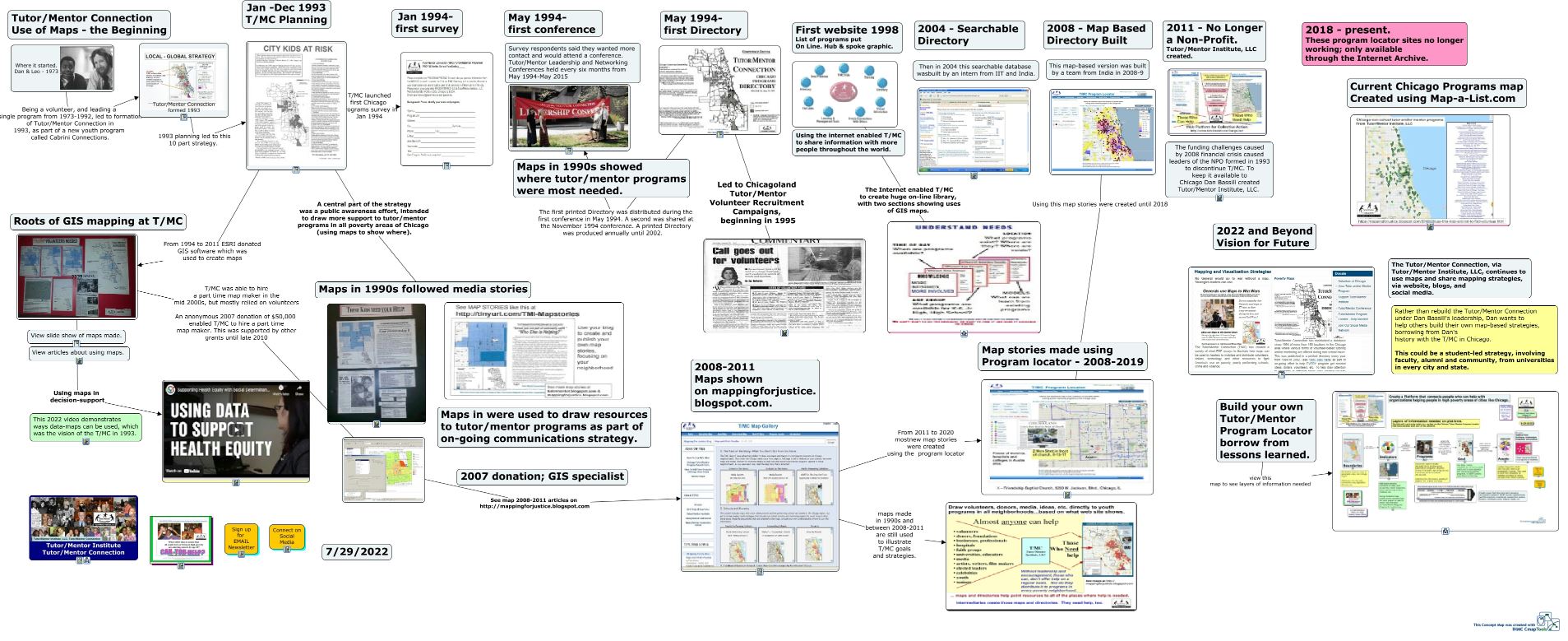
Article 1 Image
Why did one, new, small Chicago tutor/mentor program create the Tutor/Mentor Connection in 1993? - click here
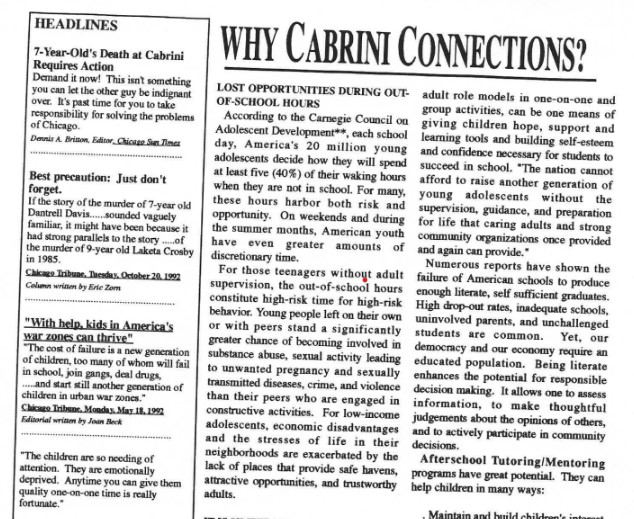
Article 2 Image
Case Statement of Tutor/Mentor Connection, from 1990s - click here
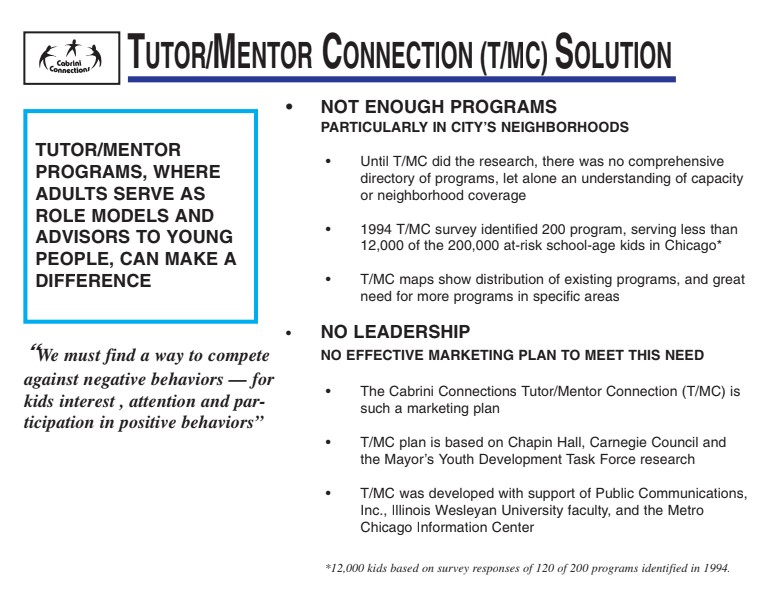
Article 3 Image
Four part strategy of Tutor/Mentor Connection, launched 1993. This is from 1990s report.  - click here
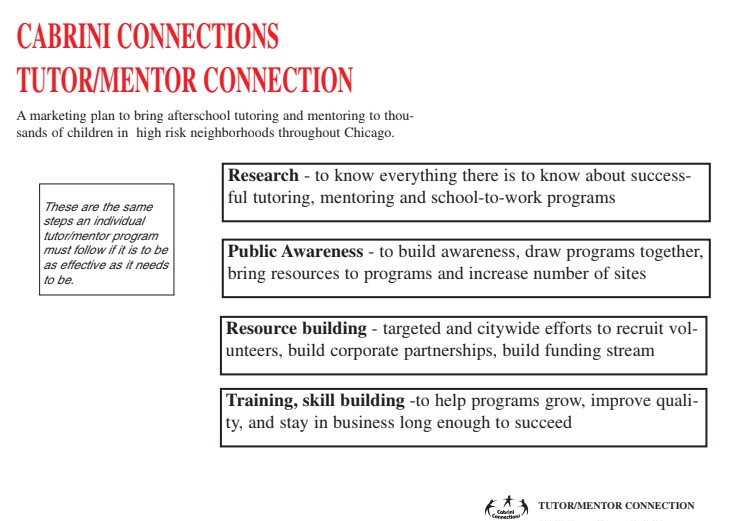
Article 4 Image

2010 University of Chicago Net Impact comparison of the Tutor/Mentor Connection in Chicago to similar intermediaries in other cities - click here
Article 5 Image
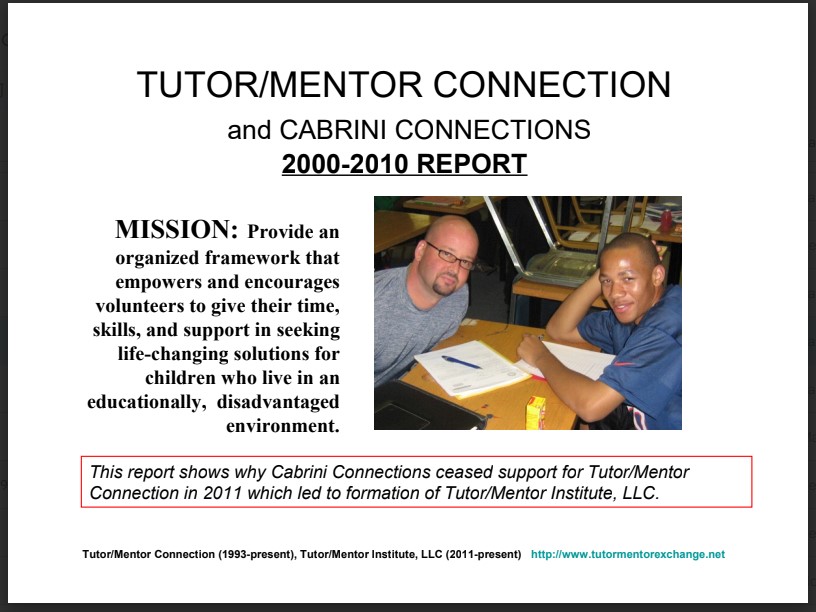
Review of 2000-2010 Tutor/Mentor Connection and Cabrini Connections tutor/mentor program - click here

2010 was the final full year that the Tutor/Mentor Connection and Cabrini Connections were a combined non-profit. In mid 2011 Dan Bassill created the Tutor/Mentor Institute, LLC to keep the T/MC alive in Chicago.

Article 6 Image
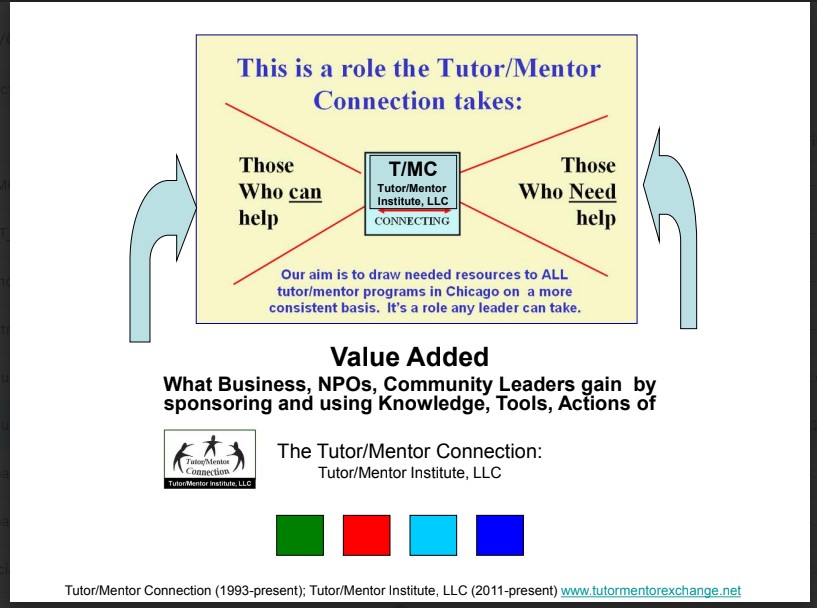
This visual essay was created in 2012 to show the value the Tutor/Mentor Institute, LLC offered to Chicago and other cities - click here 

Article 7 Image
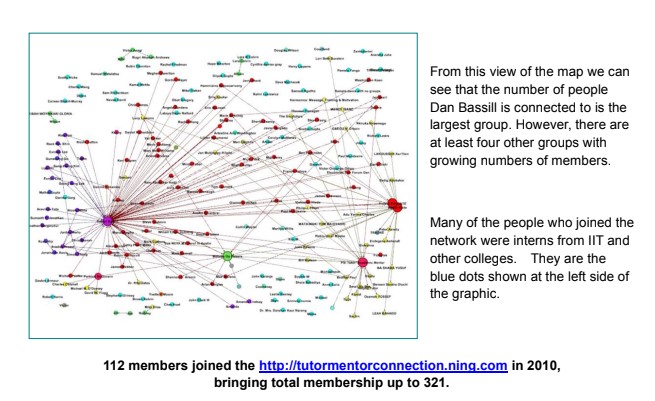
View growth of Tutor/MentorConnection network on Ning between 2007 and 2012. Work done by Chul Wan Park, and intern from South Korea - click here


Read this blog article to read about this network analysis work by Chul Wan Park and Mina Song. 

Article 8 Image
View growth of Tutor/MentorConnection network on Ning between 2007 and 2012. Report created by Mina Song, and intern from South Korea - click here
Article 9 Image
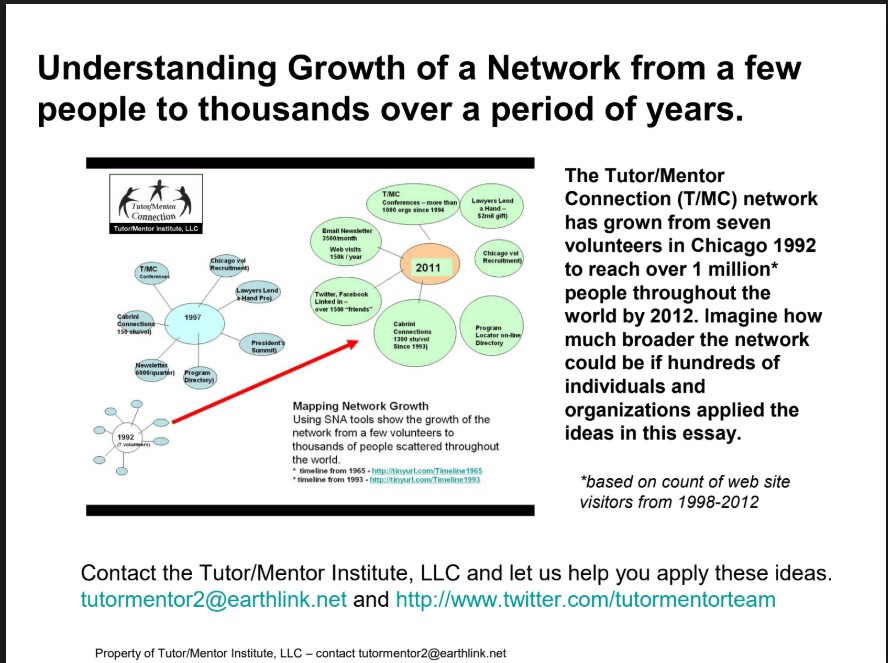
Understanding the growth of a metwork from a people to thousands of people over a period of years  - click here

This visual essay was created in 2012, showing Dan Bassill's networks on Facebook and LinkedIn, using Social Network Analysis tools. 

Article 10 Image
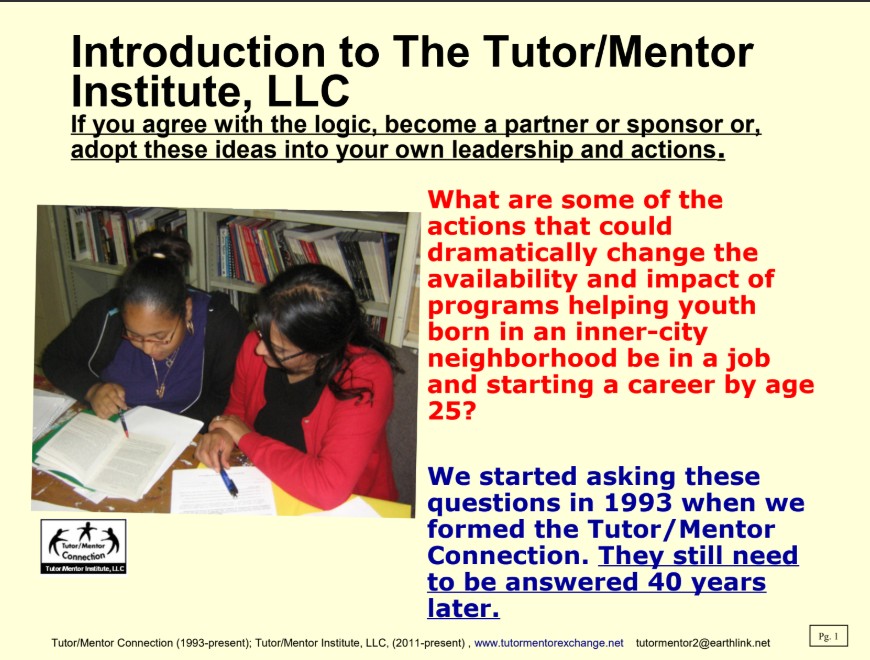
Introduction to Tutor/Mentor Connection (1993-present) and Tutor/Mentor Institute, LLC (2011-present) - click here
Article 9 Image
Master Plan for Saving Kids. 1998 review of Tutor/Mentor Connection - click here
Article 12 Image
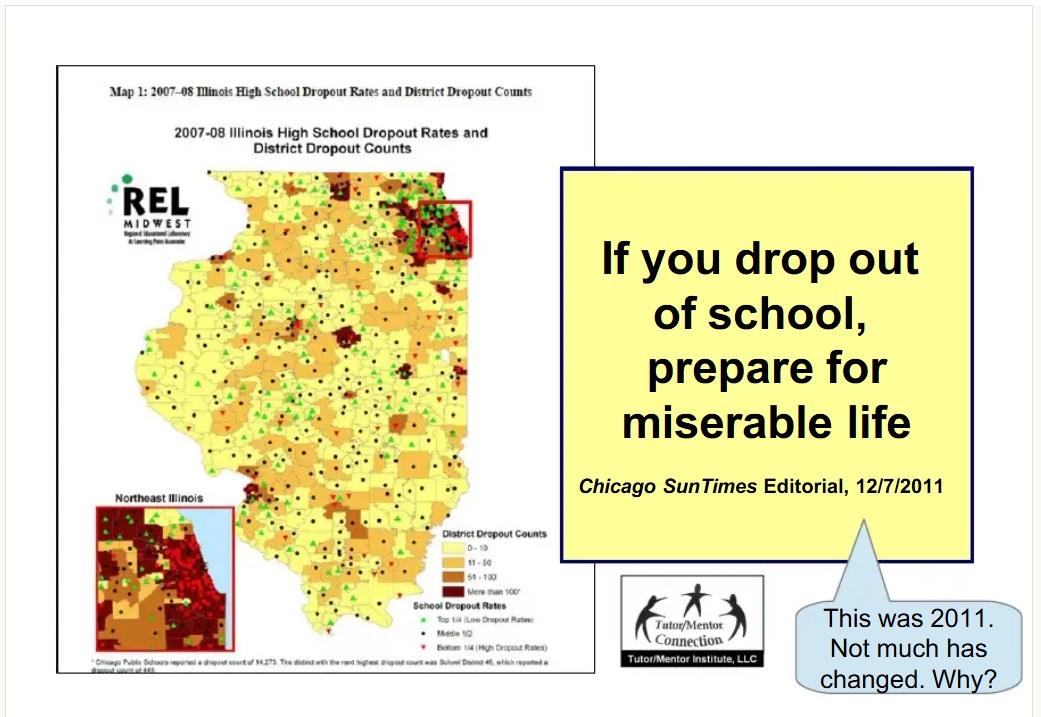
Using HS drop-out data to create a strategy that makes mentor-rich programs available to more youth - click here
Article 13 Image
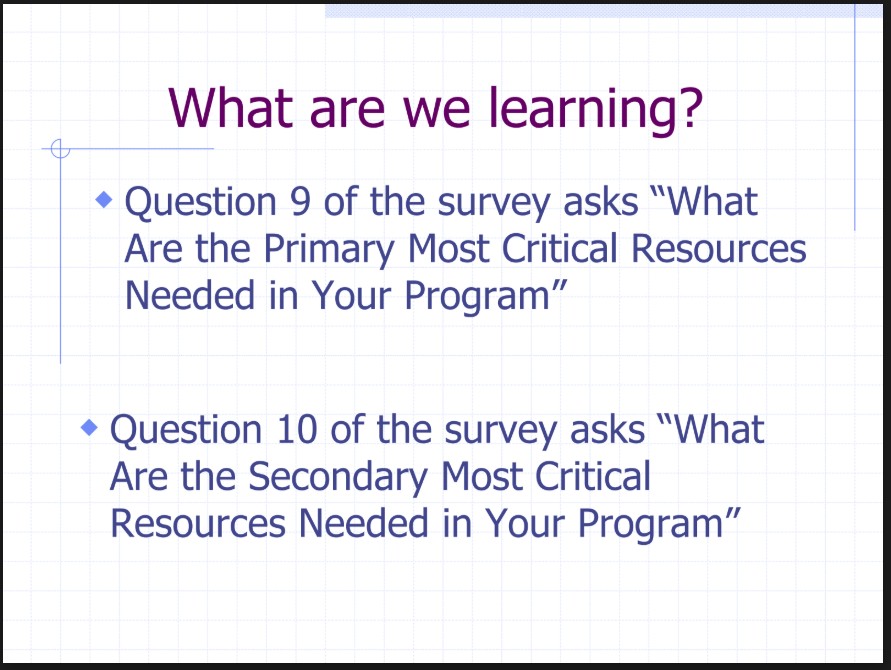
What are the primary most critical resources needed in a program? Survey results from early 2000s conferences - click here


Invitation to researchers and universities.  Adopt the Tutor/Mentor Connection. Do this type of research to build an understanding of all youth-serving programs in your community, who they serve, what challenges they face, where more are needed.  Teach other students marketing and public awareness skills that they can use to draw users to the information you collect, and to the programs operating in your community. 

Article 14 Image
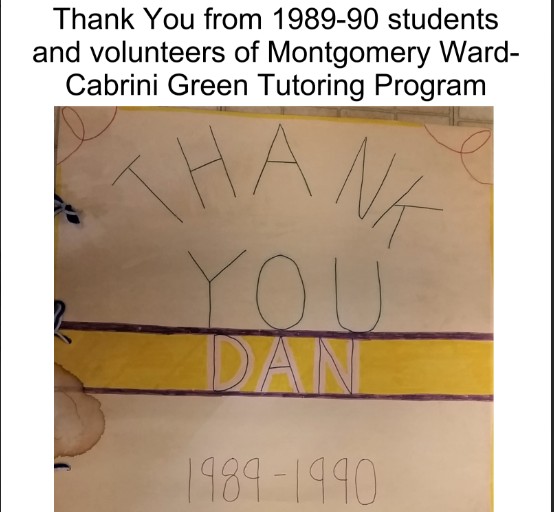
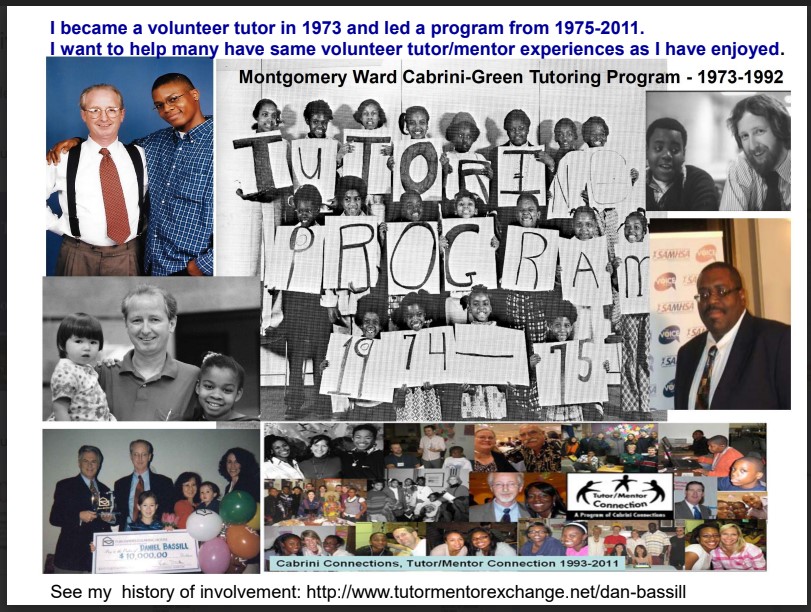
Thank you care from 1989-90 students and volunteers of the tutor/mentor program I led since 1975 -  click here

View more of our visual essays:  Page 1   Page 2   Page 3  Page 4

Visual Essays - pg 4

Since the 1970s Dan Bassill, founder of the Tutor/Mentor Connection (led by Tutor/Mentor Institute, LLC since 2011) has used visualizations to share strategies and resources. The visual essays on this page focus on starting and operating a volunteer-based tutor/mentor program.

The original collection of PDFs are listed on this page. 

Create your own versions and focus the strategies on your own city.  Show your support with a contribution. click here

Article 1 Image
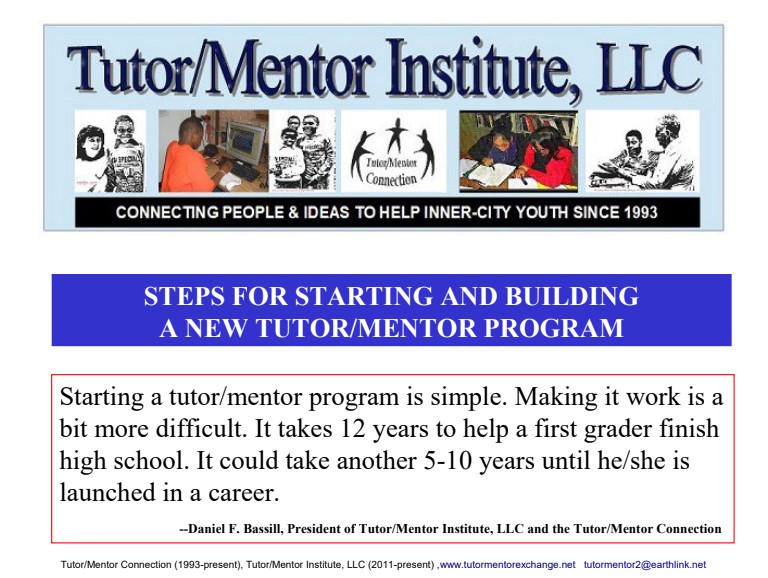
Steps to start a volunteer-based tutor/mentor program (and keep it going) - click here
Article 2 Image
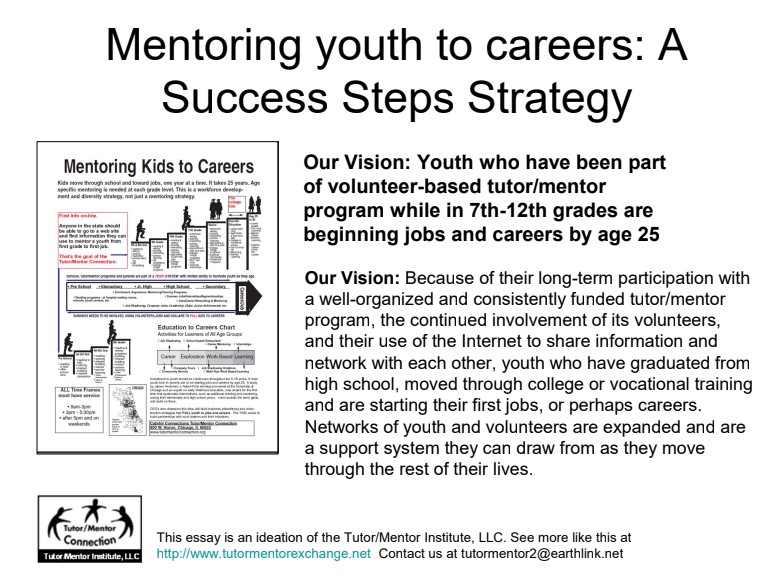
Mentoring youth through school into careers: Success Steps - click here
Article 3 Image
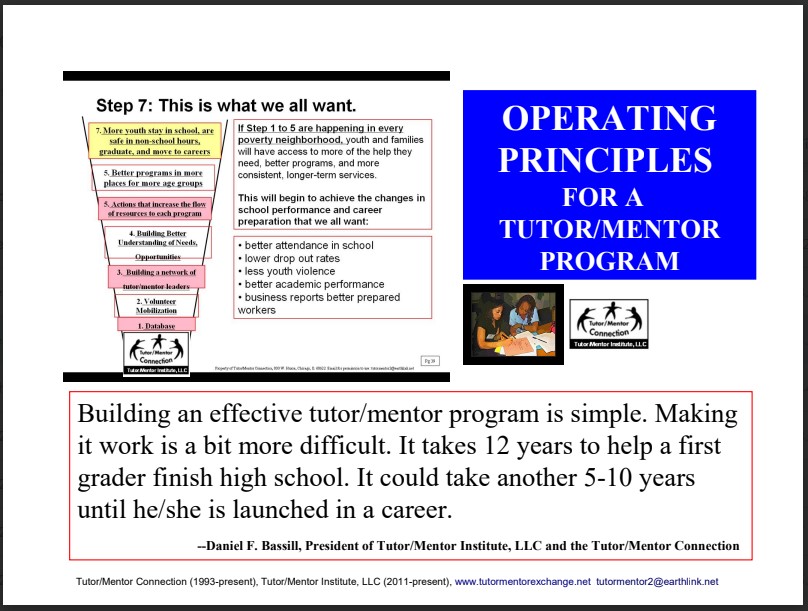
I led a volunteer-based tutor/mentor program for 35 years. What were my operating principles?  - click here
Article 4 Image
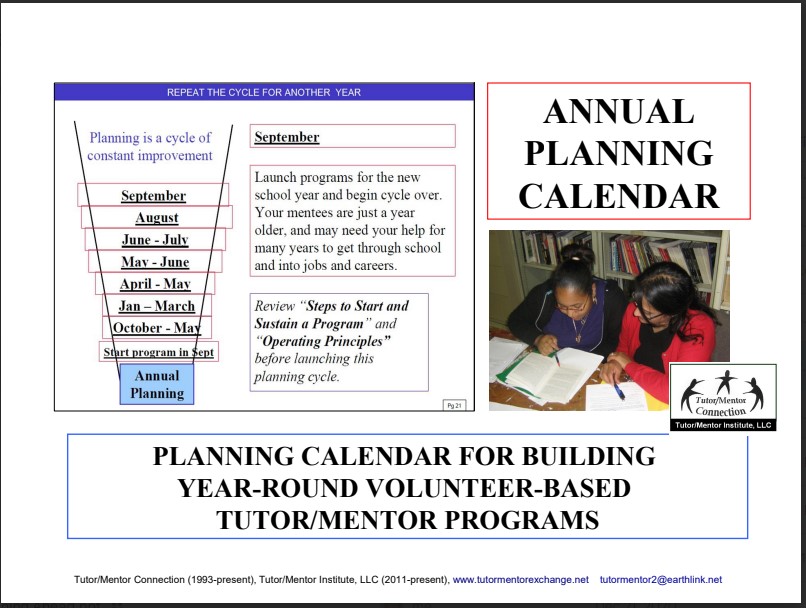
Planning year-to-year growth of a volunteer-based tutor/mentor program - click here
Article 5 Image
Strategies for recruiting volunteers for a tutor/mentor program - click here
Article 6 Image
Building a Team. Recruiting Talent. Strategies to  use - click here 

Article 7 Image
Ideas for volunteering and service. Created by intern in 2011 - click here
Article 8 Image
Resources on this website to help people build on-going programs  - click here
Article 9 Image
Learn about the resources available on this website. This shows site prior to 2025 upgrade. Content is same. Look is slighly different - click here
Article 10 Image
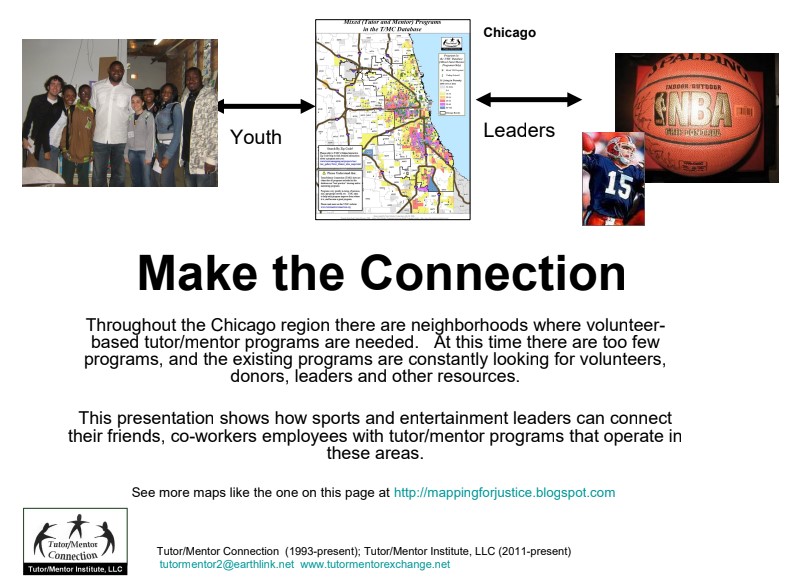
Role athletes, celebrities, CEOs, etc. can take to mobilize volunteers and donors - click here
Article 9 Image
View some of the visualizations used in Tutor/Mentor essays and blog articles - click here
Article 12 Image
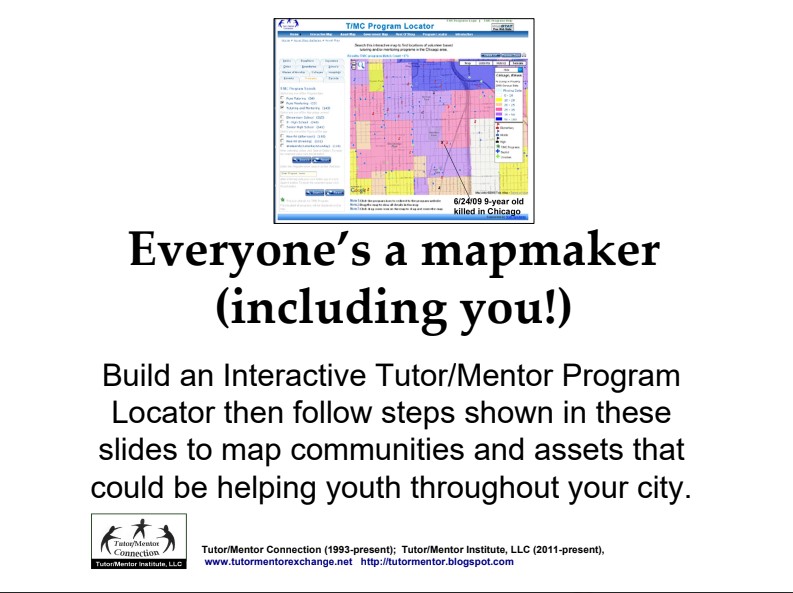
Build your own map-based directory of youth serving programs. Follow media with map stories - click here
Article 13 Image
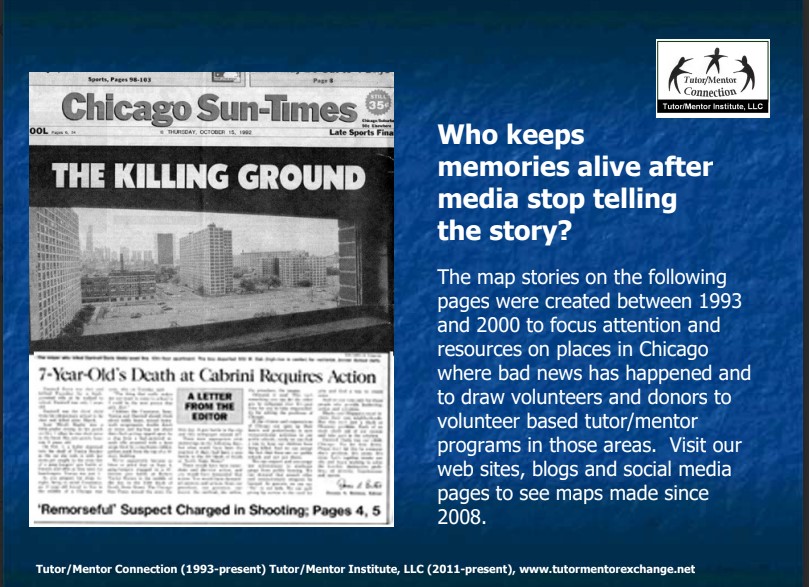
After negative news stories who keeps attention focused on area where the news happened? See use of maps - click here

View more of the maps created between 1994 and 2015 on this Ning.com site.

Article 14 Image
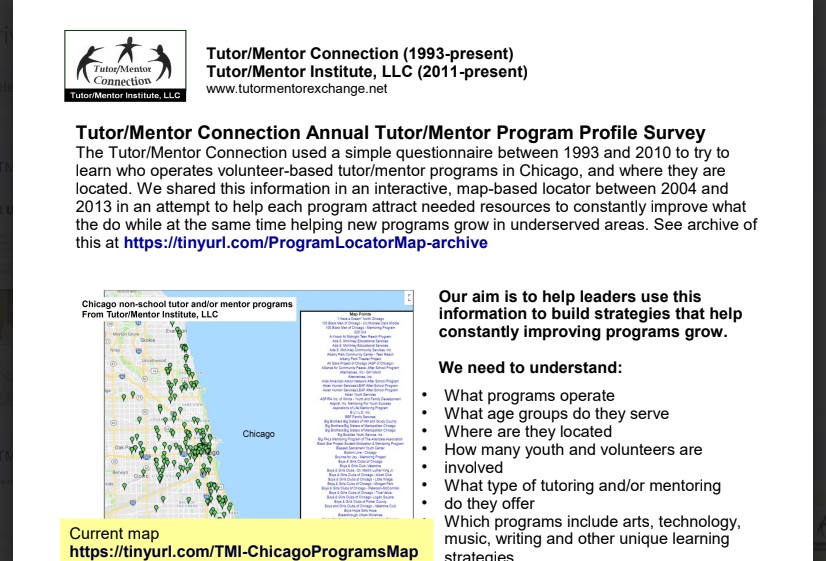
Tutor/Mentor Connection used this survey from 1994 to 2010 to learn about Chicago tutor, mentor programs -  click here

View more of our visual essays:  Page 1   Page 2   Page 3  Page 5

2 columns blog

Article 1 Image
Article Title One

This is the introductory text for the first article. It provides a brief overview of the content, designed to capture the reader's attention. The layout is responsive, ensuring a good experience across all devices.

Read More
Article 2 Image
Article Title Two

Here is the summary for the second article. Each article block is self-contained, allowing for easy management and display within the two-column structure. Images are set to be responsive using Bootstrap's `card-img-top`.

Read More
Article 3 Image
Article Title Three

This section delves into more details about the third topic. The use of Bootstrap's card component helps maintain a clean and consistent appearance for each article entry.

Read More
Article 4 Image
Article Title Four

Content for the fourth article, demonstrating how text flows underneath the image. The `h-100` class on the card ensures that cards in the same row have equal height, even if content length varies.

Read More
Article 5 Image
Article Title Five

This is the fifth article's summary. The responsive nature means these columns will stack on smaller screens, making it mobile-friendly.

Read More
Article 6 Image
Article Title Six

Details for the sixth article. You can easily replace the placeholder images (`placehold.co`) with your actual article images.

Read More
Article 7 Image
Article Title Seven

This article covers the seventh topic. Remember to adjust the `href` attributes for the "Read More" buttons to link to your actual full articles.

Read More
Article 8 Image
Article Title Eight

Summary for the eighth article. The `mb-4` class adds spacing between rows, while `mb-md-0` removes it for the right column on medium screens and up.

Read More
Article 9 Image
Article Title Nine

The ninth article's content. This structure is flexible and can be easily extended or modified to fit more articles or different layouts.

Read More
Article 10 Image
Article Title Ten

Finally, the tenth article. This comprehensive example provides a robust foundation for displaying multiple articles in a responsive two-column grid.

Read More
Article 11 Image
Article Title eleven

This section delves into more details about the third topic. The use of Bootstrap's card component helps maintain a clean and consistent appearance for each article entry.

Read More
Article 12 Image
Article Title 12

Content for the fourth article, demonstrating how text flows underneath the image. The `h-100` class on the card ensures that cards in the same row have equal height, even if content length varies.

Read More
Article 13 Image
Article Title 13

This is the fifth article's summary. The responsive nature means these columns will stack on smaller screens, making it mobile-friendly.

Read More
Article 14 Image
Article Title 14

Details for the sixth article. You can easily replace the placeholder images (`placehold.co`) with your actual article images.

Read More
Article 15 Image
Article Title 15

This article covers the seventh topic. Remember to adjust the `href` attributes for the "Read More" buttons to link to your actual full articles.

Read More
Article 16 Image
Article Title 16

Summary for the eighth article. The `mb-4` class adds spacing between rows, while `mb-md-0` removes it for the right column on medium screens and up.

Read More
Article 17 Image
Article Title 17

The ninth article's content. This structure is flexible and can be easily extended or modified to fit more articles or different layouts.

Read More
Article 18 Image
Article Title 18

Finally, the tenth article. This comprehensive example provides a robust foundation for displaying multiple articles in a responsive two-column grid.

Read More

Help Fund the Tutor/Mentor Institute, LLC - 2026

Thank you to everyone who has contributed in past years!

result


I started the Tutor/Mentor Connection in 1993 and the Tutor/Mentor Institute, LLC in 2011.

Please contribute to help me continue. (scroll down to bottom of this page to find PayPal button and/or mailing address) This entire website is full of reasons for helping me help volunteer-based tutor, mentor and learning programs grow in every area of persistent poverty. It's also a resource for any type of problem-solving!

 tipping points map

The image shown above is from a visual essay titled "Tipping Points".

It visualizes the strategies that I'm sharing and that I ask you to support with your contributions and by sharing my posts.

Rather than trying to be a single leader in a huge city, the T/MC, and now T/MI, have sought to provide an information platform that all leaders can use to LEARN, EDUCATE, and INNOVATE ways to support long-term, mentor rich, volunteer-based tutor, mentor and learning program growth in more places and to solve other complex social, political and environmental problems facing this country and the world.

With your help, I can continue.

If someone you know has become ill and needs money to pay bills, they set up a "Go Fund Me" page and ask for contributions. So, this is my "fund me" page. I (Daniel Bassill) have been self-funding most of this work since 2011, supported by a small group of continuing donors.

Please send a contribution of $25, $50, $100, $250, $500 or more to help me continue in 2026 and beyond.

Thank you for your help!

Mail contributions to:

Tutor/Mentor Institute, LLC
c/o Daniel Bassill
932 N. Salem Avenue
Arlington Heights, IL 60005

Thank you for helping me help others.
Note. The Tutor/Mentor Institute, LLC is not a 501-c-3 non profit, so your contributions are not tax deductible. They will be used to support social benefit and the lives of thousands of young people born and living in high poverty areas of Chicago and other places.

June-July 2025 T/MI News

June-July 2025 - Issue 242

Tutor Mentor Institute LLC newsletter heading with blue background

Seek out youth programs in your areas. Give them your support!

There are terrible things happening across the United States and around the world. My daily media is filled with these stories. To me, this drowns out needed calls for support for youth-serving programs in Chicago and other places.

As we head through summer toward the new school year, use the resources in my newsletter and website to find and support organized, on-going, volunteer-based tutor, mentor and learning programs. They all need your help.

At the same time, use other resources that I share to find ways to support people in your community who need help and to close the gaps that are dividing us from each other.

These resources can be used by anyone, in Chicago, or around the world.

Please share this so others in your city can find and use these resources!
Visit Tutor/Mentor Institute, LLC Website

These are social media posts from Chicago youth serving programs

This was posted on LinkedIn by Chicago Scholars, celebrating alumni who have been part of their program. It is one of many posts I see on my feed every day from Chicago area youth-serving programs.

Use this list to find many other Chicago area youth-serving programs who have accounts on LinkedIn.

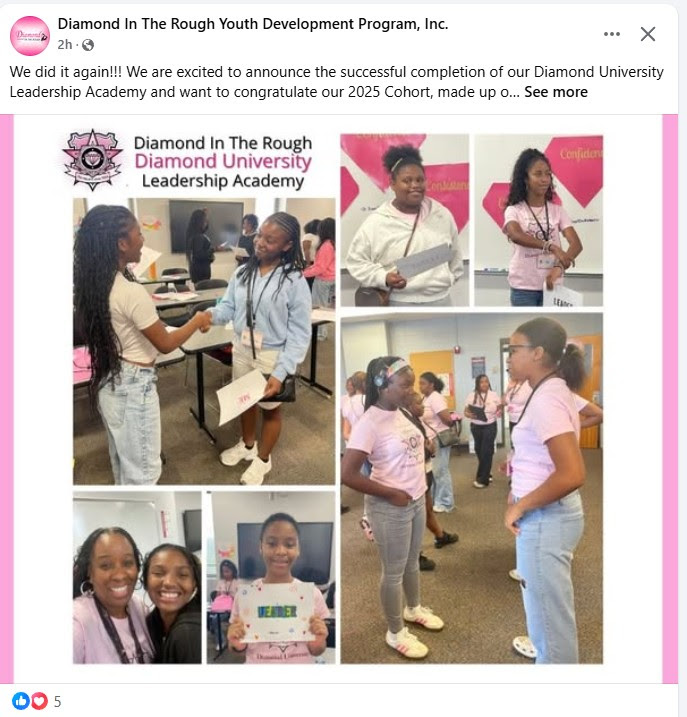
This was posted on Facebook by Diamond in the Rough Youth Development Program, Inc.

Use this list to find other Chicago area youth-serving programs who have accounts on Facebook.

Find lists of Chicago area programs using Twitter and Instagram, plus my list of tutor/mentor program websites at www.tutormentorexchange.net

One thing anyone can do to help kids living in high poverty areas is get to know existing youth serving programs and help them attract attention from media, donors, volunteers, parents and students. You can do it by sharing links to their websites or by liking and boosting their posts on social media. If you're able, you can even volunteer and/or donate.

Scroll through this set of Tutor/Mentor blog articles to see how I've highlighted work of other Chicago area volunteer-based tutor, mentor and learning programs. Do you have someone in your community hosting a website and encouraging others to draw users to it the way I do?

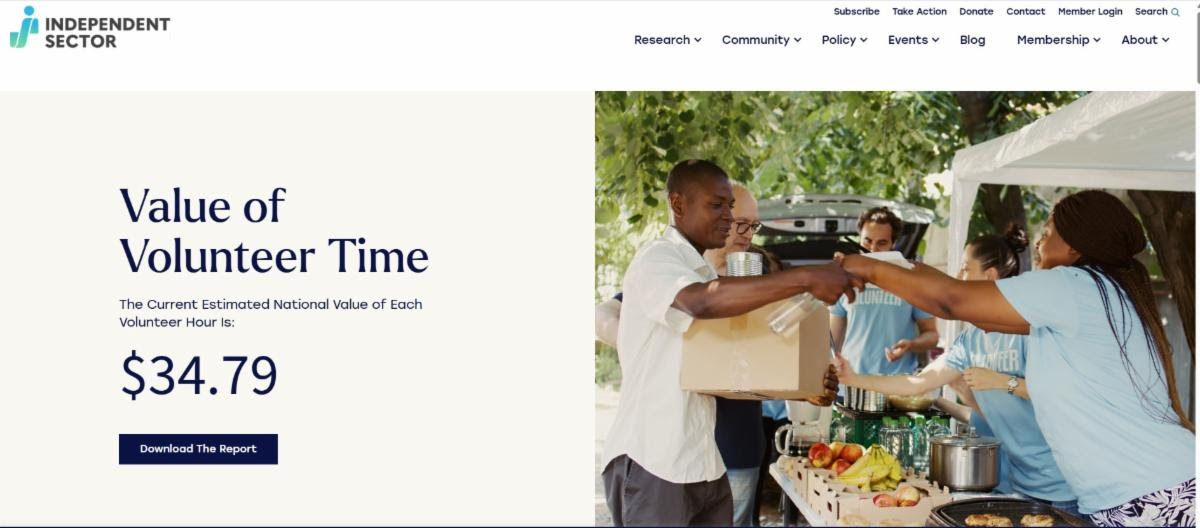
Independent Sector's annual report on the "value of volunteer time"

The Independent Sector is one of the leading resources in the philanthropic sector. One of its annual reports provides an estimated national value of each volunteer hour. Read the report at this link.

Visit the blog article section on the Independent Sector website and find leadership articles that focus on the disruption and chaos caused by actions of the current administration. click here

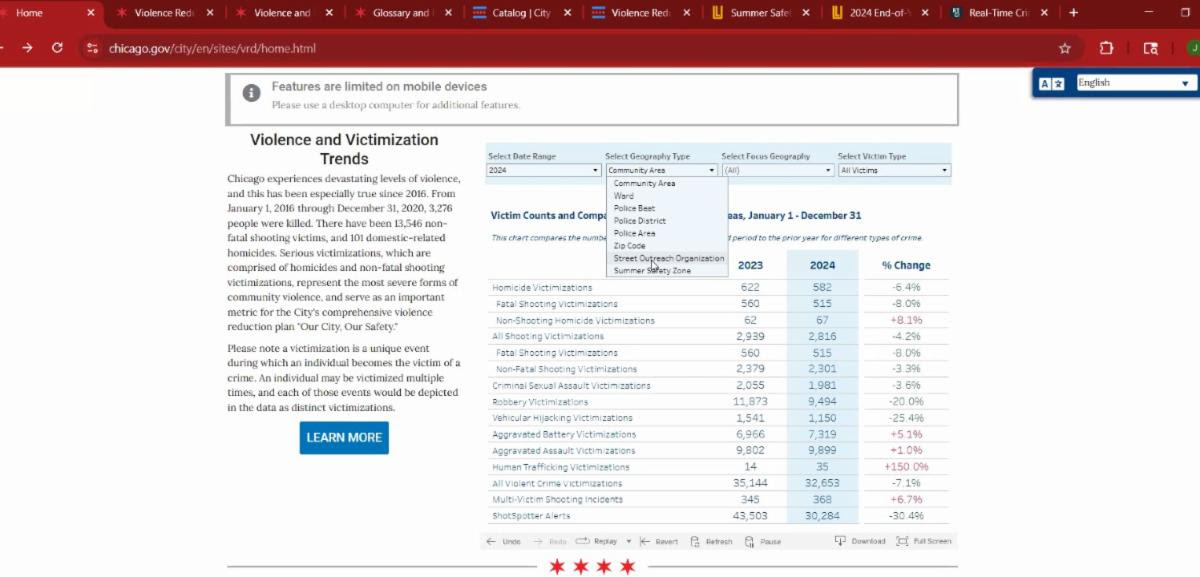
Are you aware of the City of Chicago's violence reduction dashboard, created by the University of Chicago's Urban Crime Lab? The graphic below shows one page from the website.

A few weeks ago I watched an introduction to this dashboard and its many interactive features. It's a publicly available tool launched to support efforts to reduce gun violence through transparent, real-time data. This link points to the Urban Crime Lab page that includes a video of the webinar and many other resources. View the dashboard at this link.

I wrote about the webinar and shared other screenshots on this Mapping for Justice blog article. Use your own blog to share resources like this.

Reimagining leadership in the Nonprofit Sector

I saw this message on BlueSky recently: "Nonprofits are being called on to do more with less in an impossible environment. With deepening polarization, an affordability crisis, and labour force shortages, it's time to reimagine leadership in our sector". It points to a PDF at this link.

In the mid 2000s I added another report form the Ontario nonprofit network, titled: The Constellation Model of Collaborative Social Change. view it here

These are two of many resources that can be found in the collaboration and community building sections of the Tutor/Mentor Library. Make sure your staff and volunteers are making time to learn from these.

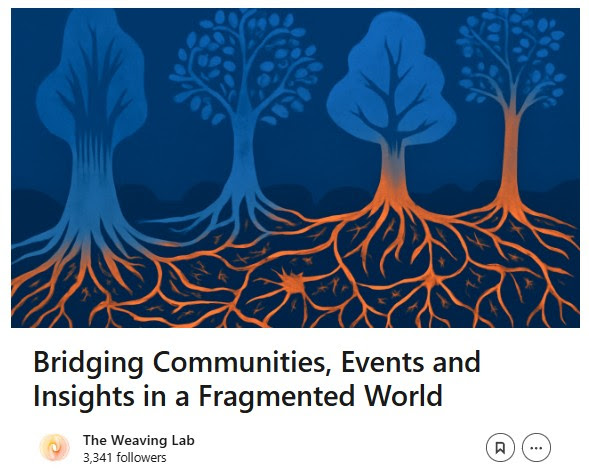
Most of the information shared in this newsletter and on the Tutor/Mentor Connection/Institute, LLC website and blogs is focused on sharing information across networks that can be used to solve complex problems. This article, from The Weaving Lab, was found on LinkedIn. It describes the network building process, its challenges and its opportunities.

If you read the post on LinkedIn you'll see a comment that I added, sharing the 4-part strategy concept map, which you can see at this link. Once I've finished upgrading the www.tutormentorexchange.net website I will add a link to this article in a sub-section focused on innovation and knowledge management. It already has many articles that I've collected over the past 20+ years.

Below are resources to use. 
View latest links added to tutor/mentor library, click here

Resources & Announcements
(New additions are at top of this list)

* Knowledge Alliance - research and evidence to support education policy - click here

* TutorCruncher - resources for tutoring companies - click here

* UCLA Center resources - Guide to Learning Supports pdf - click here; and, here

* Every Hour Counts - network of intermediaries building after school systems - click here

* MyChiMyFuture - Chicago youth programs map and directory. click here; visit the website - click here

* Chicago Mentoring Collaborative - click here

* Chicago Learning Exchange supports Out-of-School-Time community in Chicago - click here

* ACT Now - Championing Quality Afterschool Programs in Illinois - click here

* Trust Talks - podcast by The Chicago Community Trust highlights the Trust's strategic priority to close Chicago region's racial and ethnic wealth gap - click here

* Chicago Community Area Hardship Index (2019-2023) - click here

* To & Through Project website - click here

* Center for Effective Philanthropy - click here

* Forefront -Illinois' statewide association of nonprofits, foundations and advisors. click here

* AfterSchool Alliance resources - click here; New report - click here

* Chicago Public Schools locator map - click here

* National Mentoring Resource Center - click here

* Proven Tutoring clearinghouse - click here

* Chicago STEM Pathways Cooperative - click here

* South Side STEM Asset maps - read about using maps - click here

* Incarceration Reform Resource Center - click here

* Prison Policy Initiative - click here

Recent Tutor/Mentor Blog articles that point to Tutor/Mentor Connection archived files:

(Do you have a blog? Share it on social media)

Changes to this website - click here

Still judged by the color of their skin - click here

It takes a village - click here

Mapping Strategy, Ideas and libraries - click here

Poverty and racism in America - understand the issues - click here

What are your volunteers learning? - click here

Reaching youth in high poverty areas - click here


Bookmark these Tutor/Mentor Resources

* Lists of Chicago area, volunteer-based tutor, mentor programs - click here

* Homework help and volunteer training resources - click here

* Resource Library - click here

* Strategy essays by Tutor/Mentor - click here

* Work done by interns in past - click here

* Maps and Map-Stories from past 30 years - click here

* Political Action resources - click here

* Featured collections on Wakelet - click here

* Tutor/Mentor Institute Videos - click here

* About T/MI articles on blog - click here

* History of T/MC - T/MI articles - click here

* Create a New Tutor/Mentor Connection - click here

* Reaching out to Universities to adopt the Tutor/Mentor Connection strategy - click here

* Chicago Youth Serving Organizations in Intermediary Roles - click here to view a concept map showing many organizations working to help improve the lives of Chicago area youth. Follow the links.

Thank you for reading.

Please share this newsletter with people you know who work in non-school youth serving programs, or in sectors that should be strategically supporting such programs, such as business, philanthropy, education and public policy. If they are not receiving these newsletters then we have no way of engaging them. Also encourage friends, family, co-workers to sign up to receive this newsletter. 

I encourage others to duplicate what I'm doing. Write a blog and share your own vision, strategy and challenges. Share your link and I'll add it to this list in the Tutor/Mentor library.

View current and past newsletters at this link. 

To subscribe, just Click here.
(If you subscribe, don't forget to respond to the confirmation email).

Please help fund Tutor/Mentor Institute, LLC.
Visit this page and add your support.

Tutor/Mentor Connection, Tutor/Mentor Institute, LLC 

 Serving Chicago area since 1993 

This email address is being protected from spambots. You need JavaScript enabled to view it. | http://www.tutormentorexchange.net

Connect with Dan (tutormentor) on one of these social media platforms.

Twitter (X)

LinkedIn

Facebook

BlueSky

Instagram

Viewing on your phone?


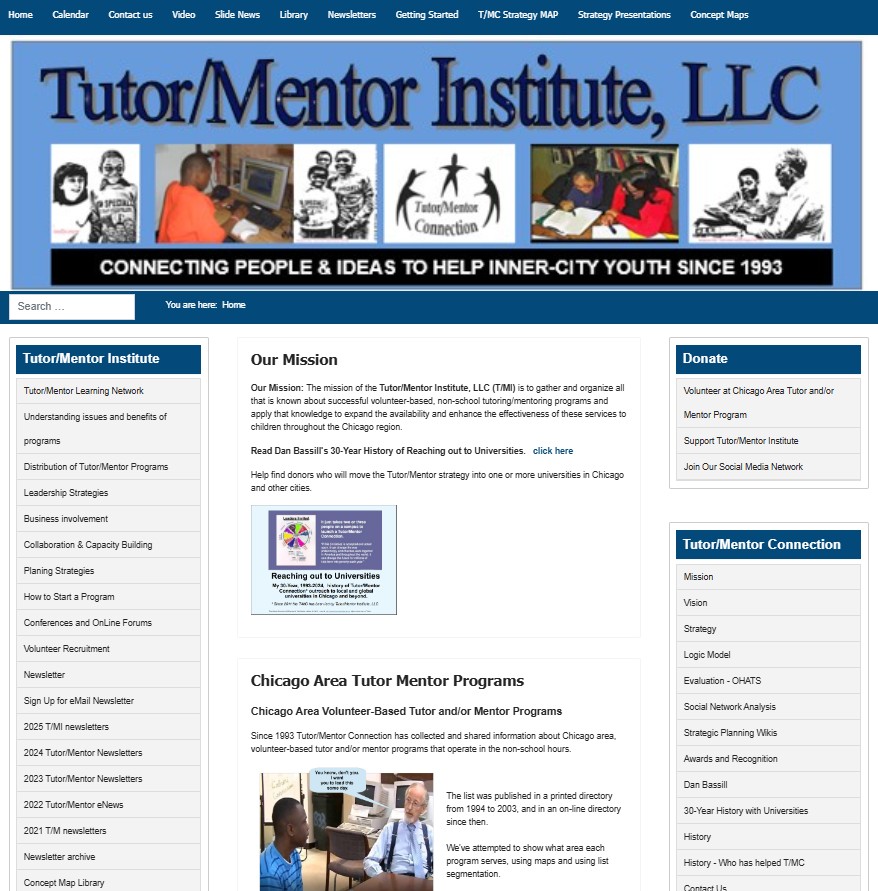
If you are viewing the Tutor/Mentor Institute, LLC website your phone you do not see the full website, which is pictured here.  Instead you will need to scroll on  your phone from section-to-section, starting with the featured content in the middle of the home page, then moving down the left side of the site, then the right.


For more information about "getting started" visit this page. 

This change is described in this blog article. 

Strategy Visualizations by Interns


Projects done by interns to help clarify and share our strategies - Page 2 of many

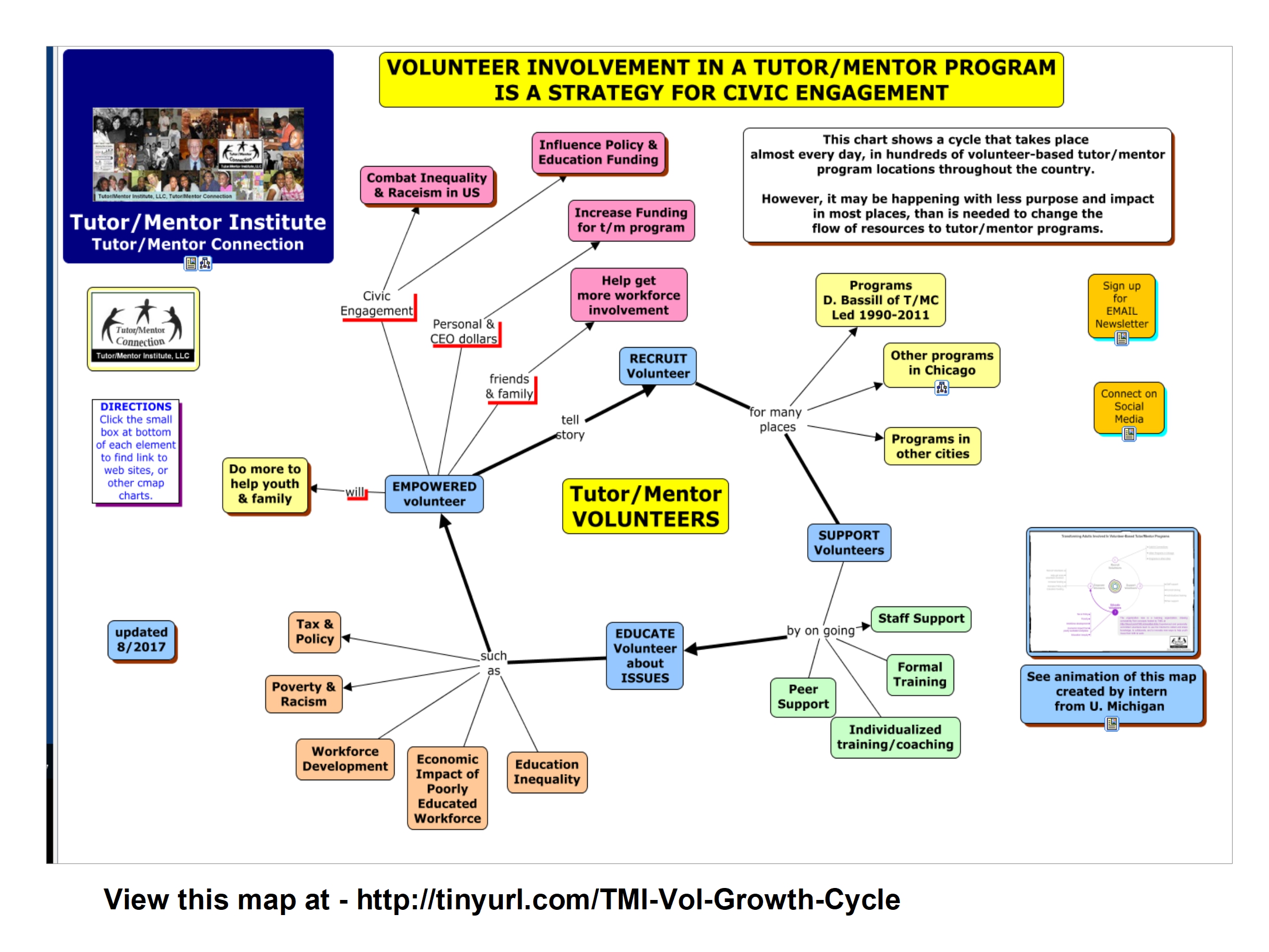
Many of the ideas that we share are in the form of pdf essays that were originally created using Power Point.  Many of the graphics and maps are included in blog articles to illustrate strategies that we hope others will support and/or adopt.  

Since 2005 interns from different universities have been converting some of these to flash animations, which help viewers build a better understanding of volunteer-based tutoring/mentoring programs, and the information that is shared by the Tutor/Mentor Institute, LLC. Please view these and apply the ideas. Share the presentations in your network. Invite students in your own school, college or tutor/mentor program to create their own interpretations.

See additional Strategy Presentations by intern: Page 1 Page 2 Page 3 View strategy videos created by interns.

Note:  Several of these projects were created using Flash animation, which no longer is supported by most browsers. If you want to view the presentation, download a swfplayer from a site like this. A YouTube video has also been created to show the animation.


This animation can be viewed on this YouTube site.

It can also be seen in this Video

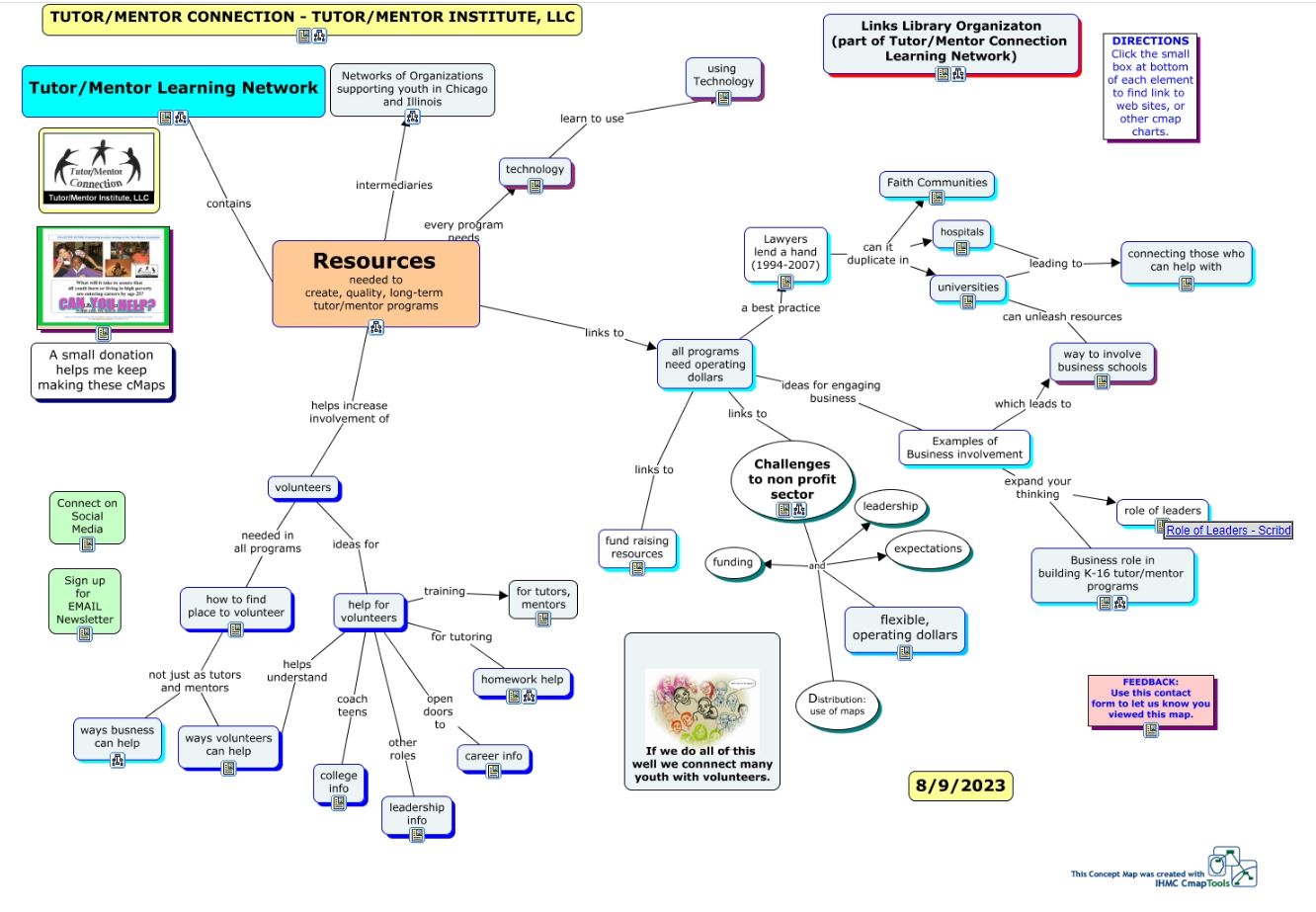
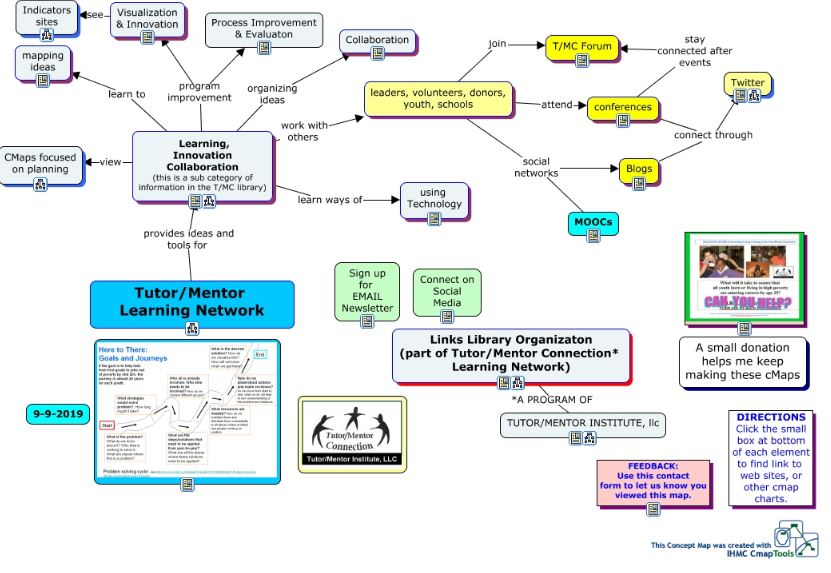
This STRATEGY MAP animation was built using this concept map as the original idea.

Visit this forum to see how projects are introduced to interns and how they are coached to complete them.

We are hope

This graphic is from an intern project completed in Feb. 2012. Parts of
it were included in this video.

Volunteer
This animation can be seen in this YouTube video.   

This 2010 presentation, created by a University of Michigan Grad student, explains how volunteers grow as a result of longer-term involvement in a tutor/mentor program.  Note: you may need to download swfplayer to view animation. http://www.tutormentorexchange.net/images/flash/vol_leadership.swf

View this presentation video to see the many resources available in the Tutor/Mentor Connection Learning Library. See Flash Animation using link below. Note: you may need to download swfplayer to view animation.

http://www.tutormentorexchange.net//images/flash/resourcesmap.swf

year-round strategy

Year Round Strategy of Tutor/Mentor Connection. See in YouTube video.

See  new version in this 2017 YouTube Video.

This Flash Animation presentation was created by an intern from South Korea, via IIT, in 2010 It illustrates the Tutor/Mentor Connection's Quarterly Events strategy. Creating year round visibility. 

You may need to download swfplayer to view the animation.

  • Role of Many Leaders - video version

    Flash animation version, This was created in 2010 by an intern from South Korea.. Illustrates the power of individuals, businesses, faith groups and colleges. Download swfplayer to view.


This Learning Path concept map can be seen here.

in 2015, Wona Chang, an intern from South Korea, created this video to guide you through the map. 

(Wona originally created this using Prezi, and created a Korean language version, too. That is no longer available)

push pull flash


View video of this presentation.

Download swfplayer to view animated view of this push pull graphic., shown in this blog article.  


This graphic was created  in 2007 by one of our first interns from Hong Kong borrowing from ideas in this PDF  essay.  The animation is no longer available, but you can see it's development in this 2007 blog article.


See video of this Flash animation.


This is a revised version of the animation created in 2007. The new version was created by In Hee Cho in 2011.  Flash animation is no longer available.

Return to page 1

Concept Maps; Visualization

"AND? IT'S ALL CONNECTED," - A SYSTEMS THINKING APPROACH
click here
This site is described as "a work under development presenting my (Gene Bellinger's) current understanding which has evolved from my four decade journey from systems thinker to storyteller." 
If you're interested in solving complex problems visit this link then read through the pages. Purchase a subscription if you choose, but it's not required to build an understanding. You need a password to log in and view.

A 2025 UPDATE OF GENE BELLINGER'S SYSTEMS THINKING LIBRARY
click here
This site is related to the "And, It's all Connected" site.  It is named "Gene's 2nd Brain" which is (as he says) "where I attempt to organize everything I touch that seems meaningful. Well, at least to me."  This site uses an interactive concept mapping/visualization tool to organize hundreds, if not thousands, of links.  Spend some time becoming familiar with it. Re-visit often. Create your own version. No password needed.


A BETTER WORLD BY DESIGN
http://betterworldxdesign.com/about.html
From the web site: "Each year, Better World by Design brings a global community of innovators to Providence, Rhode Island to reach across disciplines and unite under a common goal: building a better world. Presenters share engaging stories, workshops teach creative skills, and discussions re-frame perspectives. Better World is an immersive experience that deepens our understanding of the power of design, technology, and enterprise to engage our communities and sustain our environment."

A BLOG THAT COMMUNICATES VISUAL THINKING IDEAS
https://darmano.typepad.com/logic_emotion/visual-thinking-synthesis.html
This site provides a lot of ideas and information for why and how people can integrate visualization into their thinking and communications. These are concepts the Tutor/Mentor Connection seeks to incorporate into its efforts

A COLLECTION OF KUMU SYSTEMS THINKING PROJECTS 
https://blog.kumu.io/introducing-projects-in-the-wild-5528050de844
https://kumu.io/kumu/projects-in-the-wild
This blog article is titled "Projects in the Wild" and hosts a growing list of projects that use KUMU to "design simple, thoughtful solutions that help us work in complexity".  This should be a great resource for any who are using KUMU or any form of concept mapping tools, or who are trying to solve complex problems.  

ACTION PLANNING FOR TEACHERS (AND MENTORS)
http://www.nefstem.org/teacher_guide/prep/index.htm
From the web site: "This guide for classroom action research was created by teachers for teachers. The resources here were designed to support reflective and systematic improvement of teaching.  Use the tabs at the top of each page on this web site to explore the stages of action research. The planning steps are outlined visually, and can be used by leaders of volunteer-based tutor/mentor programs as well as by teachers in traditional public schools."

AID TO NETWORKS - MONITOR INSTITUTE BY DELOITTE
https://www2.deloitte.com/us/en/blog/monitor-institute-blog.html?icid=nav2_social-innovation-blog
From the web site: "Monitor Institute by Deloitte works with social impact leaders to help surface and pioneer "next" practices—breakthrough approaches for societal challenges. As part of Monitor Group and now at Deloitte LLP, the team has catalyzed progress on some of the pressing issues of our time."

AMBIGUITY - ORGANIZING THOUGHTS USING X-MIND AI
https://dougbelshaw.com/blog/2025/11/22/organising-ambiguity/
https://app.xmind.com/share/Qh213vkj?xid=qUPrCvKU
https://xmind.com/ai
Here's a blog article titled "Organizing some thoughts around ambiguity" in which the author shares a concept map created using X-Mind AI.  Add this to your tool box for mind mapping and concept mapping. 

AN INFORMATION VISUALIZATION CLASS - WHAT TO LEARN
https://ella.sice.indiana.edu/~katy/S637-S08/
This link is to the 2008 Information Visualization course being taught by Dr. Katy Börner at the University of Indiana. It provides a detailed outline of the learning, with numerous links to on-line resources, that her class will go through to build expertise in this area. 

AN OVERVIEW OF CURRENT SOCIAL MEDIA RESEARCH TOOLS
https://blogs.lse.ac.uk/impactofsocialsciences/2015/07/10/social-media-research-tools-overview/
In this article,  "Wasim Ahmed presents a quick look at some of the tools available to social scientists for analysing social media data and also reflects on the limitations of the platforms and the methods used for this type of research."

APPLY SYSTEMS THINKING IN STRATEGIC PLANNING
http://hainescentre.com/rollercoaster/
This is one of many articles available on the web site of the Haines Centre for Strategic Management®. 

APPRECIATIVE INQUIRY COMMUNITY INTERNATIONAL
https://www.facebook.com/groups/AICInternational/
Appreciative Inquiry Community International is a Facebook group that will "connect, share, combine and co-develop the practices based on Appreciative Inquiry and other strength based practices and aim to spread these practices."

BETWEEN FRIENDS-THE VALUE OF THE "SOCIAL GRAPH."
https://www.technologyreview.com/2008/02/19/221950/between-friends-2/
This 2008 article from "Visual Matters" site offers some ideas describes a social graph, a representation of a person's network of friends.

BOSTON DATA COMMONS - INTEGRATES VISUALIZATIONS
https://datacommon.mapc.org/
From the web site:  "The MetroBoston DataCommon provides a wealth of information about the region’s people and communities through a variety of topics -- from arts and education to the environment and transportation. A resource for all those seeking to understand how the region is changing, it helps residents, stakeholders, planners, city and town officials, educators and journalists explore data and make informed decisions. We invite you to explore its data, community snapshots and create your own visualizations and reports.

BUCKMINSTER FULLER INSTITUTE - INSPIRING AND SUPPORTING A NEW GENERATION OF AUDACIOUS DESIGN INITIATIVES
https://www.bfi.org/
From the website: "Buckminster Fuller developed the new discipline of Comprehensive Anticipatory Design Science to support a whole systems approach to "make the world work for 100% of humanity in the shortest time possible."  We are expanding this work, making it available in new ways, and actively applying it to urgent global challenges."

CAMBRIDGE DOUGHNUT PROJECT - OUTLINED USING KUMU.IO
https://www.kumu.io/lstabler10/cambridge-doughnut-project-plan-sandbox#flowchart
From the website: "This collaborative model originated with the Cambridge Doughnut Project Plan by Lauren Stabler https://kumu.io/lstabler10/cambridge-doughnut-project-plan and contributions by Brian Dowling through New Community Paradigms"
The concept map created, using Kumu.io, demonstrates a unique community engagement planning process, and the potential of concept mapping tools like Kumu.io.  

CODE PEN - A SOCIAL DEVELOPMENT ENVIRONMENT FOR DEVELOPERS
https://codepen.io/
From the website: "CodePen is a social development environment for front-end designers and developers.  Build and deploy a website, show off your work, build test cases to learn and debug, and find inspiration.The best place to build, test, and discover front-end code."

COLLECTING MEANINGFUL DATA ABOUT YOUR NETWORK - USING SNA
click here
This is an article that talks about using data and network analysis to understand networks. Here's the introduction: "The effectiveness of any collaborative effort — whether it’s a network or an organization — depends primarily on the strength of the connections that exist between the participants involved. Social network analysis (SNA), using mapping tools like Gephi or Kumu, is the most effective method currently available for visualizing that connectivity and for evaluating a collaboration’s effectiveness. However, SNA is only useful if it is constructed with meaningful data and applied with the “so what” in mind.

CONCEPT MAPPING. WORLDWIDE MAPS
http://www.2wmaps.com/
From the web site: "The WWMAPS project organizes cultural exchange relations and construction of structures of knowledge between students from geographically distant countries and language. The difficulties of communication and distance are both solvable through the use of concept maps, made with appropriate software and shared in a network environment. Software and network environment are both provided by CmapTools, a free program very easy to use."

CONCEPT MAPS AID KNOWLEDGE MODELING AND SHARING - CMAP TOOLS
https://cmap.ihmc.us/
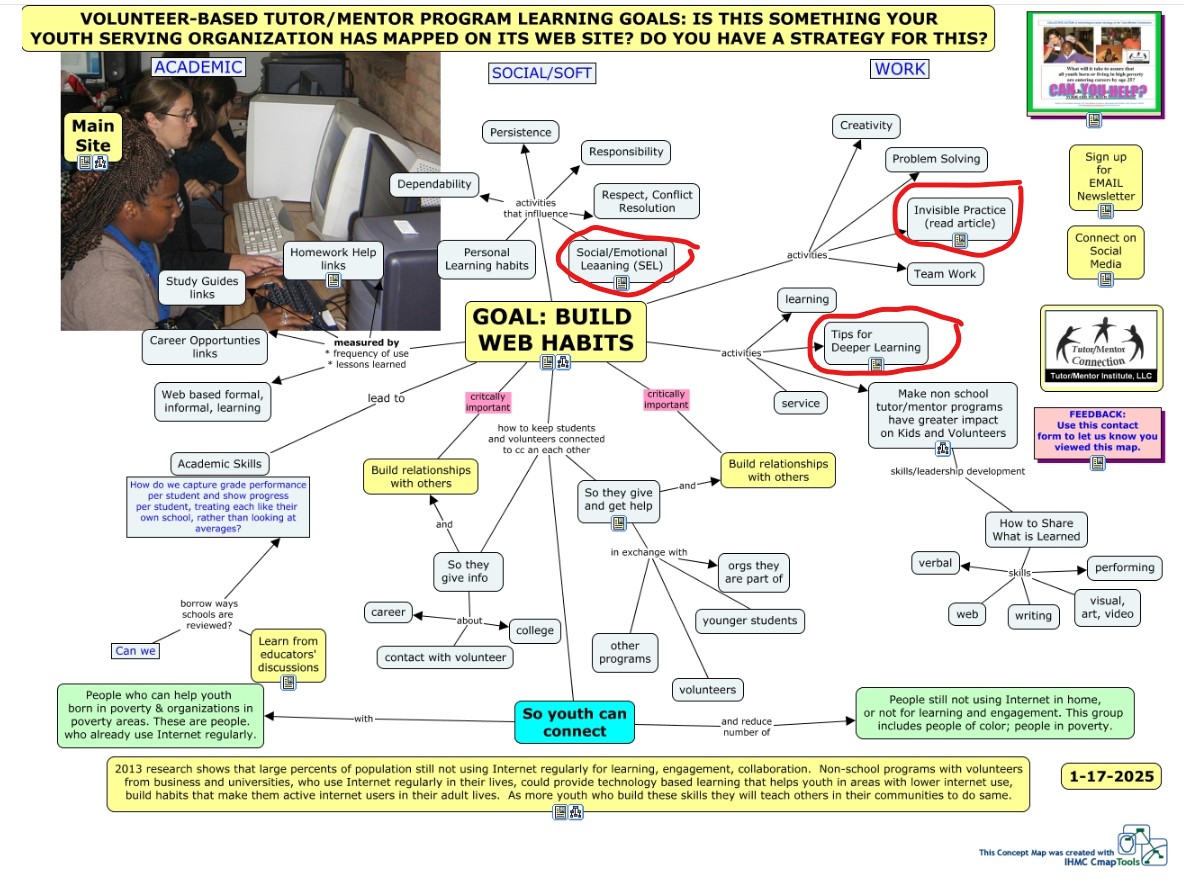
From the web site: "Concept maps are graphical tools for organizing and representing knowledge in an organized fashion. Learn what concept maps are, how to construct them, and use them."    Note: The Tutor/Mentor Connection and Tutor/Mentor Institute, LLC have been using CMap tools since 2005 to visualize strategy and resources available to visitors of our web sites.  We're looking for partners to help map concepts of the T/MC. See Leadership Commitment Strategy Map - http://tinyurl.com/tmc-strategy-map

CONCEPT MAPPING AND MINDMAPPING INTRODUCTION
https://www.patreon.com/posts/concept-mapping-15313656
This article by Howard Rheingold is a useful introduction to concept maps and mind mapping. 

CREATE CONCEPT MAPS (OR MIND MAPS) USING ARTIFICAL INTELLIGENCE - TRY WHIMSICAL
https://whimsical.com/
The Whimsical platform offers quick, easy tools to create mind maps, concept maps, flow charts, wireframes, etc.  There is a FREE starter version but then there are fees for use.  This video shows an Artificial Intelligence tool that can be used in creating mind maps and concept maps. https://www.youtube.com/watch?v=IbJwXWN2SHg


CYNEFIN MODEL - LOOKING AT COMPLEX PROBLEMS
https://en.wikipedia.org/wiki/Cynefin_framework
This model of complex problem solving is one that can be applied to our efforts to surround inner city kids with learning and mentoring that leads to long-term benefits for kids, industry, and communities.  This link goes to a Wikipedia definition.

DATA STORY-TELLING TOOLS - 30 BEST - 2017 ARTICLE
https://medium.com/@ToTheVictor/nicar30tools-da83db0f3dc6
This article point to tools many of us might use to tell effective stories. 

DATA VISUALIZATION BY CLEVERFRANKE - EXAMPLES OF WHAT'S POSSIBLE  
https://www.cleverfranke.com/
View the video on the home page to see the range of data visualization work done by this company.  Visit http://www.cmap.illinois.gov/mobility/explore#/ to see website created for CMAP in Chicago.

DATA VISUALIZATION AND INTERACTIVE TOOLS ON HANYS (HEALTHCARE ASSOCIATION OF NEW YORK STATE) WEBSITE
https://www.hanys.org/data/
This section of the HANYS website shows data visualizations created to support the mission of the Healthcare Association of New York State.  

DATA VISUALIZATION EXAMPLES FROM ACROSS THE WEB CREATED WITH TABLEAU PUBLIC.
https://public.tableau.com/en-us/gallery/?tab=viz-of-the-day&type=viz-of-the-day
These are examples of products created using Tableau data visualization software. 

DATA VISUALIZATION EXAMPLES FROM STAMEN - 2016 WORK
click here
This article points to data visualization projects Stamen worked on in 2016 and demonstrates the wide range of ways data can be visualized.

DATAINTERFACES - FORMATS FOR DATA-RICH SCENARIOS
http://www.datainterfaces.org/category/projects/
From the web site: "DataInterfaces is a research laboatory that merges the competences of communication design, complex systems science, and computer science in the creation of interfaces betwee data and people."

DATAWRAPPER RIVER
https://app.datawrapper.de/river/faq
From the website: "The Datawrapper River is a place to exchange charts and maps with other Datawrapper users. After adding a chart to the River, anyone can use it and customize the chart in Datawrapper before publishing it on their website in their own style. The River is bridging the gap between Data-Haves and Have-Nots. Scientists, NGOs and government institutions will reach more people. And journalists will be able to find and use data with less time spent on searching, cleaning, visualizing. Ideally, the River can work like a “wire service for charts”"

DEMONSTRATION OF USE OF VISUALIZATION - CREATING A NEW PARADIGM FOR HOW WE INTERACT WITH THE PLANET'S OCEANS
https://oceanreturns.com/the-ocean-system/index.html
This presentation "Explores the interrelation between healthy markets, thriving communities and flourishing ecosystems".  View the video. Look at the graphics. Read the descriptions. Then explore the Kumu.io map.  

DEMONSTRATION OF USE OF CONCEPT MAPS
http://www.nwlink.com/~donclark/about/conceptmap.html
This site is one of the largest non-commercial training and development sites on the web. In this section the site uses a concept map to help visitors navigate the information on the site.

EDUCATION AROUND THE WORLD - GREAT WEBSITE
http://visualdata.dw.com/specials/bildung/en/enrollment.html
This site includes graphs and interactive charts that offer insight into the rates of literacy among men and women in various regions around the globe and examines school enrollment and educational expenditures in individual countries. Nearly all of the data is based on statistics collected by UNESCO.  Excellent example of uses of visualization technologies.

E-LEARNING TUTORAL ON VISUALIZATIATION
https://www.visual-literacy.org/
From the web site: "This e-learning site focuses on a critical, but often neglected skill for business, communication, and engineering students, namely visual literacy, or the ability to evaluate, apply, or create conceptual visual representations. After this tutorial, students should be able to evaluate advantages and disadvantages of visual representations, to improve their shortcomings, to use them to create and communicate knowledge, or to devise new ways of representing insights. 

EVERY SINGLE COGNITIVE BIAS IN ONE INFOGRAPHIC
https://www.visualcapitalist.com/every-single-cognitive-bias/
This is just one of many infograpics on this site. Take a look.

EVIDENCE SHOWING VALUE OF VISUAL PORTFOLIO MAPPING
https://www.visualcapitalist.com/every-single-cognitive-bias/#mce_temp_url#
This article shows research done that provides "empirical evidence that visualization directly and positively impacts business outcomes."

EXAMPLES OF DATA VISUALIZATION FROM 2012 GLOBAL VOICES CITIZEN MEDIA SUMMIT
https://summit2012.globalvoices.org/2012/07/visualizing-data-at-global-voices/
This blog and the audio provide many ideas for using visualization of data to share ideas.

GAPMINDER PROVIDES FACTS ABOUT WHAT'S HAPPENING IN WORLD
https://www.gapminder.org/tools/#$chart-type=bubbles&url=v1
From the website: "Gapminder is an independent Swedish foundation with no political, religious or economic affiliations. Gapminder is a fact tank, not a think tank. Gapminder fights devastating misconceptions about global development. Gapminder produces free teaching resources making the world understandable based on reliable statistics. Gapminder promotes a fact-based worldview everyone can understand." The website has a huge library of information that is visually shared. Take time to get familiar with it.

GENETIC ATLAS OF HUMAN ADMIXTURE HISTORY - MAPPED USING GOOGLE MAPS
https://www.gapminder.org/tools/#$chart-type=bubbles&url=v1
This map demonstrates a creative use of GIS mapping and data visualization. It shows research done to understand human DNA and its history, and how humans have spread around the globe over the past 4000 years. See related article in NY Times.

GLOBAL FUTURES SOCIETY NETWORK MAP - MADE  USING KUMU.IO
https://www.dubaifuture.ae/global-futures-society
https://kumu.io/gfs/gfs-mapping#gfs-map
From the website: "The Global Futures Society (GFS) Network Map is a strategic tool designed to visually represent the member organisations, and individual members in addition to the relationships between them. In a field as diverse and dynamic as foresight, it can be challenging to track ongoing projects, partnerships, and initiatives. The GFS Network Map addresses this by offering a clear, interactive view of how the membership are connected, what they're focused on, and how their efforts contribute to shaping the future."


GLOBAL PRIORITIES FLOW CHART - HOW TO GET INVOLVED?
http://globalprioritiesproject.org/2015/09/flowhart/
Want to make a difference in the world? Where to start? This flow chart offers a lot of ideas to consider.

HOW SYSTEMS MAPPING CAN HELP YOU BUILD A BETTER THEORY OF CHANGE
https://blog.kumu.io/how-systems-mapping-can-help-you-build-a-better-theory-of-change-4c85ae4301a8
Applying systems thinking and concept mapping to planning process and to communicating your theory of change is the focus of this article.

IDEA MAPPING SUCCESS
http://ideamappingsuccess.com/
From the web site: "Idea Mapping is a powerful whole-brained visual thinking tool that enhances memory, note-taking skills, thought organization, planning, creativity, and communication.  It uses color, keywords, lines and images to connect thoughts associatively.  Idea Maps are the natural expression of the way the brain processes information associatively. (See more examples on this site and many more on the Idea Mapping Blog)"

INTERACTIVE PRESENTATION - SYSTEMS THINKING + YOUTH UNEMPLOYMENT IN BOTSWANA
https://piercegordon1.kumu.io/system-thinking-youth-unemployment-in-botswana
This presentation uses the Kumu.io software to create an  interactive visual presentation showing challenges facing young people in Botswana as they try to find employment.

INTERACTIVE SYSTEMS THINKING - YOUTH EMPOYMENT MAP - SHOWING BARRIERS AND OPPORTUNITIES FOR YOUNG PEOPLE IN ENGLAND
https://youthfuturesfoundation.org/our-work/identify/youth-employment-system-map/
This interactive casual loop diagram map was created by the Youth Futures Foundation in 2021 to map the youth employment system in England.  From the website: "It provides a visual representation of the barriers and opportunities young people from marginalised backgrounds face as they seek good jobs."

INTERNATIONAL NETWORK FOR SOCIAL NETWORK ANALYSIS
https://www.insna.org/
This is a web site for researchers interested in social network analysis (SNA). We can learn much about SNA by browsing the various sections of this site.

KNOWLEDGE VISUALIZATION
http://knowledgevisualization.blogspot.com/
This blog show some interesting visualizations with links to other web sites. Last updated in 2006. Articles still relevant.

KNOW-WHY-NET IMODELER - VISUALIZATION AND ANALYSIS OF INTERCONNECTIONS
https://www.know-why.net/
From the web site. "KNOW-WHY.NET is an international platform for sharing models from different fields. The models are developed and presented using the iMODELER, which is arguably one of the leading tools available for the visualization and analysis of interconnections. The basic iMODELER is free, but there is also a more powerful paid full version available. The models can be explored directly in your browser."

KUMU - A POWERFUL CLOUD-BASED VISUALIZATION PLATFORM
https://kumu.io/tour
Kumu is a powerful, flexible concept mapping platform, capable of mapping complexity of all kinds. Visit the website to learn about all the features. Join the FREE Kumu community.

LANDSCAPE OF CONSCIOUNESS INTERACTIVE VISUALIZATION
https://loc.closertotruth.com/interactive
From the website: "This 4-map interactive visualizes theories of consciouness, showing category, scholarly/scientific interests, complexity, and connections with one another. It's valuable if this is a topic you're interested in and as a demonstration of what's possible using interactive visualization tools."

LITTLESIS - A TOOL FOR MAPPING POWER RELATIONSHIPS
https://littlesis.org/toolkit/
https://littlesis.org/resources/
From the website: "LittleSis is a free, open-source research platform.  It is a database of who-knows-who at the heights of business and government and a p owerful tool for strategic research.  This toolkit has been designed to provide people with the tools to conduct power research and develop a research pod, or crew of folks, that have the skills to investigate local corporate bodies and organize against them.  You can use this toolkit as a starting point for organizing around a common target with your neighbors and friends,or to strengthen the work of your organization."

MARCELIO: REVOLUTIONIZING SCIENTIFIC INFORMATION MANAGEMENT
https://doi.org/10.5281/zenodo.17525893
https://kumu.io/craisistemas/mapa-interactivo-micelio
These links point to a data visualization created by a team at the José Simeón Cañas University of Central America (UCA) using KUMU, and to a report introducing Micelio, described as "the implementation of the first DSpace-CRIS in El Salvador. If you know of other universities in the world with this type of information managment system please share your links on LinkedIn. 

MAPPING COMPLEXITY USING KUMU
https://csl4d.wordpress.com/2014/06/25/wicked-solutions-major-influences/
This 2014 article titled "Wicked Solutions: Major Influences" offers tips for using KUMU to map complex relationships. The KUMU platform has made many enhancements since then.

MAPPING COMPLEXITY USING KUMU - SEE LINKS IN TUTOR/MENTOR BLOG ARTICLES
https://tutormentor.blogspot.com/search/label/Kumu
Some of the articles posted on the Tutor/Mentor blog have updates at the bottom, with new links found after the original article was posted.  This link points to articles about KUMU and other concept mapping tools.

MAPPING WICKED PROBLEMS - BLOG 
https://www.wicked7.org/category/wicked-problem/
This website has many blog articles that use concept maps to visualize ultra complex problems.  Most focus on questions like "What are the most urgent issues facing society?  How did we get there? What are the root causes? What must be done now?".  

MIND MAPS USED FOR BIBLE STUDY - BLOG
http://petrabthg.blogspot.com/2011/12/effective-bible-study-with-mind-mapping.html
Browse through articles on this blog and see how concept maps/mind maps are used to outline passages in the Bible and create deeper understanding.  Hope to find people in faith communities using mind maps to visualize strategies for helping the poor climb out of poverty.


NATIONAL NEIGHBORHOOD INDICATORS PROJECT
https://www.neighborhoodindicators.org/activities/issues
From the web site: "The National Neighborhood Indicators Partnership (NNIP) works to build local capacity, plans joint activities, and works in conjunction with affiliated organizations.

In recent years all NNIP partners have built advanced information systems with integrated and recurrently updated information on neighborhood conditions in their cities. Creation of this capacity, which did not exist in any U.S. city two decades ago, represents an important technical and institutional breakthrough." 

NETWORK MAPPING - OPTIMICE.COM
https://www.optimice.com.au/
This site illustrates a way to map who you're connected with and provides many other ideas on social network analysis.

NETWORK VISUALIZATION TOOLS - ARTICLE BY DR. VERONICA ESPINOZA 
https://medium.com/@vespinozag/16-network-visualization-tools-that-you-should-know-2c26957b707e
This article provides a brief description of 16 network visualization tools, and includes a story to demonstrate how each can be used.

NETWORK WEAVING TOOLS USER GROUP
https://q.health.org.uk/get-involved/events/network-weaving-tools-users-group-meet-up
This UK based platform supports sharing of ideas about meeting-focused tools created by the Network Weaving online group.  This is one of an on-going series of ZOOM meetings hosted by this group. 

OPEN INDICATORS CONSORTIUM (OIC) - ARCHIVE
https://www.neighborhoodindicators.org/activities/projects/open-indicators-consortium-weave
From the web site: "The Open Indicators Consortium (OIC), which operated from 2008 to 2014, was founded by partners from across the United States who came together to support and guide the development of the Weave software and its application as a high-performance open source data analysis and visualization platform free to all. The consortium’s goal was to transform publicly available data into visually compelling and actionable indicators to inform public policy and community-based decision makers.  An independent firm took over the development of the software in 2016.

ORGNET - SOCIAL NETWORK ANALYSIS SOFTWARE AND SERVICES
http://www.orgnet.com/about.html
From the web site: "Valdis Krebs, Founder and Chief Scientist, at Orgnet, LLC is a management consultant, researcher, trainer, author, and the developer of InFlow software for social & organizational network analysis."  This site provides a wealth of understanding about concepts of social network analysis, as well as services that can be purchased for doing this work.

PARTICIPATORY COMMUNITY MAPPING AS COLLECTIVE SENSEMAKING - 5 PART INTERVIEW W ALDO De MOOR
https://greaterthanthesum.com/aldo1
https://greaterthanthesum.com/aldo5/
This set of articles on the Greater than the Sum website, provide valuable insight into participatory mapping as a crucial methodology for social intervention. My link points to the 5th article in the series, and to the first.


PARTNER- TOOLS TO ASSESS PARTNERSHIPS/COLLABORATION
Greater than the Sum - first article/
From the web site: "PARTNER is a social network analysis tool designed to measure and monitor collaboration among people/organizations. The tool is designed for use by collaboratives/coalitions to demonstrate how members are connected, how resources are leveraged and exchanged, the levels of trust, and to link outcomes to the process of collaboration."

PLANET SCHOOL - MIND MAPPING VISUALIZATION
https://www.mindmeister.com/106237621/planet-school-the-idea/
This mind map was used to describe the Planet School strategy.

POWER MAPPING - LEARN TO USE CONCEPT MAPS TO IDENTIFY WHO HAS THE POWER TO FIX THE PROBLEM YOU WANT FIXED.
https://commonslibrary.org/power-mapping-to-design-a-winning-campaign-strategy/
This is an article from The Commons Social Change Library.  It describes a powerful planning and visualization skill, which it called "power mapping". The article recommends,  "Use it to figure out who has the most influence over the issue you are focused on and who is most likely to give you what you want."  This is a skill Tutor/Mentor Connection (1993-present) and Tutor/Mentor Institute, LLC (2011-present) have tried to master for many years. Here's one article from our blog. https://tutormentor.blogspot.com/2025/03/mapping-ideas-information-and-networks.html

PREZI - ENGAGE YOUR AUDIENCE. BLOG ARTICLE
https://peterpappas.com/2009/02/prezi-engage-your-audience-with-a-zooming-nonlineal-presentation.html
This blog article describes a web based collaboration and visualization tool called Prezi.

Note:  Visit this page to see how interns use Prezi to share Tutor/Mentor Institute, LLC ideas. http://www.tutormentorexchange.net/definition-of-issues/ideasanimation/intern-strategies

PROJECT 990 IS BUILDING COMPREHENSIVE DATA ANALYTICS PLATFORM TO SUPPORT THE NONPROFIT SECTOR, POLICYMAKERS AND THE PUBLIC
https://project990.org/
https://public.tableau.com/app/profile/fulton/vizzes
https://www.linkedin.com/company/smartcharityai/
Visit this site to learn how Project 990 is "building a comprehensive data analytics platform that integrates information from millions of tax filings, grants, and other sources related to  philanthropic giving." See how Project 990 is visualizing the funding flow across the nonprofit sector. See examples of their work on the Smart Charity LinkedIn page and on this Tableau website. 

REDESIGN NETWORK - DESIGNDIALOGUES
https://designdialogues.com/design-business-as-agents-of-world-benefit/
From the website: "The Redesign Network works internationally across a wide community of great people. We create successful and enduring information resources for complex practices and work. Redesign advocates systemic design for practice and services, based on understanding the patterns and meaning of human activity. adapting innovative methods from interpretive and empirical traditions." 

ROOT CAUSE OF POVERTY - SOME RECOMMENDED READING
http://tutormentor.blogspot.com/2012/04/increase-in-homicides-what-is-root.html
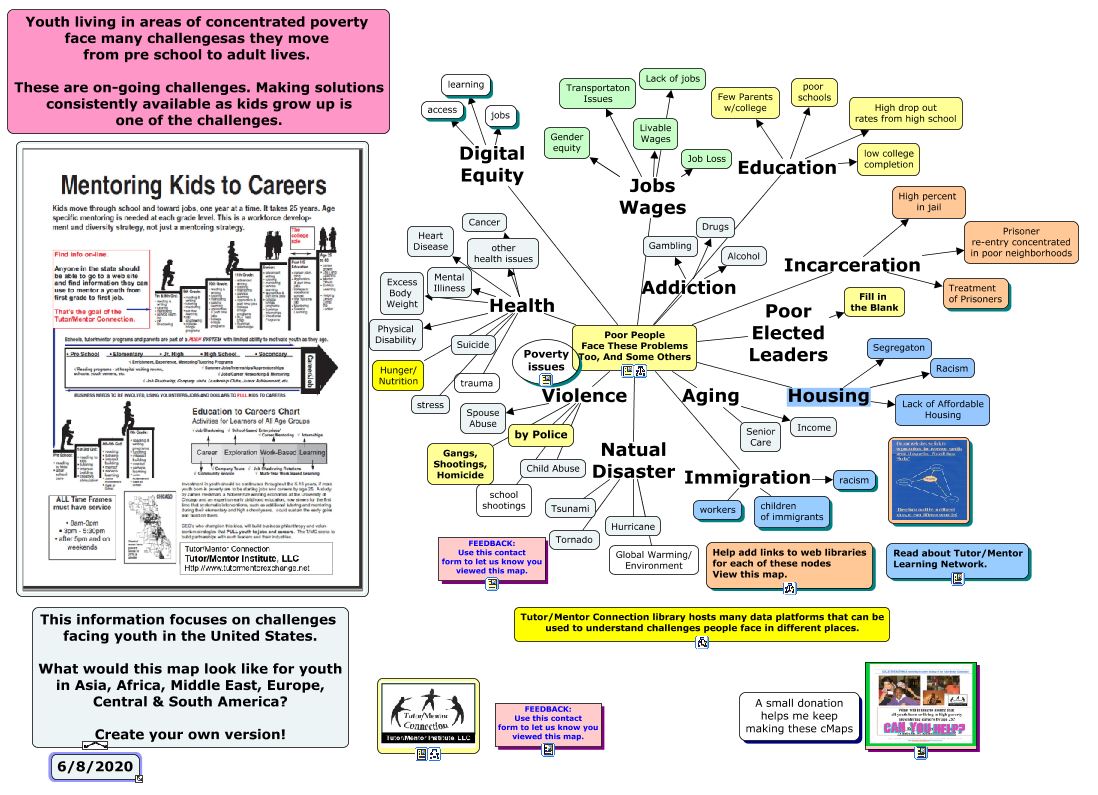
In this Tutor/Mentor Institute, LLC blog article I've aggregated some links to articles showing "root cause analysis" and thinking. If we can understand the basic causes that lead to acts of urban violence and to kids under-performing in school and life we might have a better chance of mobilizing resources to remove these causes.

SERVICE DESIGN TOOLS
https://servicedesigntools.org/
From the web site: "Service Design Tools is conceived as an open platform of knowledge, to be shared with the design research community."

SMITHSONIAN OPEN ACCESS - DOWNLOAD, SHARE AND REUSE MILLIONS OF THE SMITHSONIAN'S IMAGES
https://www.si.edu/openaccess
This looks like a great resource for creators and communicators.  The Smithsonian has made available more than 4.5 million 2D and 3D digital items from their collections that anyone can share and reuse, right now, without asking.  Take a look. 

SOCIAL CHANGE ECOSYSTEM MAP
https://buildingmovement.org/our-work/movement-building/social-change-ecosystem-map/
From the website:  "This is a framework that can help individuals, networks, and organizations align and get in right relationship with social change values, individual roles, and the broader ecosystem. Download the map, accompanying materials, and more from the website."

SOCIAL NETWORK ANALYSIS TOOLS - LIST INCLUDES FREE AND OPEN SOURCE
http://www.butleranalytics.com/20-free-and-open-source-social-network-analysis-software/
If you're interested in understanding groups and networks, this list of tools you might use can be valuable to you.

SOCIAL NETWORK MAPPING - NODEXL - TUTORIAL
https://mappingforjustice.blogspot.com/2015/09/mapping-social-media-networks-nodexl.html
This blog article includes links to various sites where you can learn how to use NodeXL, a free, open source tool, to map participation in social networks.

STANFORD UNIVERSITY DSCHOOL (DESIGN)
https://dschool.stanford.edu/field-notes
Browse the different sections of this web site to see all the ways the Stanford University dSchool "helps people unlock their creative potential and apply it to the world."

STRATEGY MAPPING - STRATEGIC COMMUNICATIONS
https://www.valuebasedmanagement.net/methods_strategy_maps_strategic_communication.html
This web site illustrates the value of using concept maps in communications of strategy.

STUDIO BOOMWEHMEYER - EXPLORES DIFFERENT PERSPECTIVES AROUND SOCIETY, CULTURE AND CRAFTSMANSHIP.
http://boomwehmeyer.com/
From the web site: "This website functions as archive for objects, making and academic processes.  Working together with a variety of  partners, academies and institutes studio BoomWehmeyer explores different perspectives around society, culture and craftsmanship. The studio work stems from an active mentality to work together on the expanding consciousness and roles of designers in today’s rapidly transforming, technological, social and cultural landscape. Many projects are grounded in research and maker-ship as core ingredient in their activities."

SYSTEMS THINKING AND VISUALIZATION TUTORIAL
http://systems.open.ac.uk/materials/T552/
From the web site :"The Systems Group at the Open University is committed to the study, application and development of systems ideas. We aim to help people make sense of -- and intervene in -- complex and interconnected situations. We work with a wide range of issues and settings including: environmental decision-making for sustainable development; information systems management; organisational change in both public and private sectors; and integrated waste management." This link points to examples of different kinds of systems maps that the Open University Systems Group has developed over the years. It's an interactive site that helps users explore the ways in which different kinds of 'diagramming' can be used in a systemic inquiry.

SYSTEMS THINKING TOOLS - A REFERENCE GUILD (PDF)
https://thesystemsthinker.com/systems-thinking-tools-a-users-reference-guide/
From the web site, "Whether you are new to systems thinking or merely need a guide to available tools, this collection introduces you to dynamic, structural, and computer-based tools – from stocks and flows to causal loop diagrams and management flight simulators."

UNDERSTANDING SOCIAL NETWORKS - VISUALIZING NETWORKS
https://cambridge-intelligence.com/use-cases/social-networks/?goback=.gde_1314427_member_5811084457679028224#!
From the web site: "Network dynamics dictate the spread of information, news and ideas. They can help identify someone’s tastes, opinions and activity. If we can understand a person’s network, we will have a much deeper knowledge of them than if we assessed them in isolation.

By studying a social network we can find influential people, anticipate peaks in demand for products or services, generate more targeted marketing approaches and predict illegal activity. On a more personal level, we can also build communities, identify vulnerable and isolated people and help people find new connections." Read the White Paper on this site.

UNDERSTANDING SOCIAL NETWORKS ON TWITTER
click here
This article talks about how social network analysis can help build an understanding of the different ways people group and interact on Twitter. For those working to draw people from social networks to a specific interest area, or a product/service, this offers a building block of understanding.

URBAN DESIGN COURSES ON RACE AND JUSTICE - NEEDED
click here
This CityLab article says "Black students at Harvard’s Graduate School of Design say there are no design courses that consider race and justice. Here’s an outline for one."  Visit the site and use the ideas.

USING CMAPTOOLS TO CREATE CONCEPT MAPS
click here
This article, titled "Visual Connections for Museums" demonstrates uses of cMap Tools to create concept maps. Read the article and dig into the maps. 

USING NETWORK ANALYSIS AND SOCIAL MEDIA FOR PLANNING & ANALYZING A CONFERENCE
click here
This article shows how network analysis, using #nodeXL, was used in planning a conference and in understanding participation after the event. This is one of many related and interesting articles on the #ScottPublicHealth blog.

USING NETWORK ANALYSIS TO UNDERSTAND GIT HUB NETWORK
https://sbaack.com/blog/scraping-the-global-civic-tech-community-on-github-part-2.html
This article not only provides an understanding of people/organizations who use the GitHub web site, but also demonstrates how this type of analysis might be applied to help build  understanding of groups focusing on other social/economic/environmental and health issues in the world.

UX MAPPING METHODS COMPARED: A CHEAT SHEET
https://www.nngroup.com/articles/ux-mapping-cheat-sheet/
From the article: "Empathy maps, customer journey maps, experience maps, and service blueprints depict different processes and have different goals, yet they all build common ground within an organization." This article describes all four types of mapping, using visualizations to illustrate ideas.

VENSIM - SIMULATION SOFTWARE FOR IMPROVING THE PERFORMANCE OF REAL SYSTEMS.
https://vensim.com/
From the web site: "Vensim is used for constructing models of business, scientific, environmental, and social systems. Ventana Systems also provides strategic management consulting using dynamic simulation models."  The site contains many articles and resources.

VISUAL COMPLEXITY - AGGREGATION OF NETWORKS
http://www.visualcomplexity.com/vc/about.cfm
From the web site: "VisualComplexity.com intends to be a unified resource space for anyone interested in the visualization of complex networks. The project's main goal is to leverage a critical understanding of different visualization methods, across a series of disciplines, as diverse as Biology, Social Networks or the World Wide Web."   The goal is that "this space can inspire, motivate and enlighten any person doing research on this field."

VISUAL LANGUAGE AND ROBERT HORN
http://pictureitsolved.com/resources/principles/robert-horn-and-visual-language/
This article introduces Robert Horn, who, "In his most recent book, Visual Language: Global Communication for the 21st Century, Robert Horn defines visual language as the integration of words, images, and shapes into a single communication unit. " Follow the links and learn more.

VISUALLY RECORD A CONVERSATION
https://visualthinkery.com/project/visually-recording-a-conversation/
This article on the Visual Thinkery site provides steps for visually recording a conversation.  It's part of the creative process ideas shared on the site.

VISUALIZATION METHODS - A TABLE OF CONTENTS
https://www.visual-literacy.org/periodic_table/periodic_table.html
This web site offers a comprehensive map of the various types of visualization methods with links to each example

VISUALIZATION MODELS - SUSTAINABILITY
https://computingforsustainability.com/2009/03/15/visualising-sustainability/
This 2009 site has collected over 280 graphics that visualize sustainability strategies. As you look to communicate ideas this provides numerous examples of ways to do this.

VISUALIZATION OF UNIVERSAL BASIC INFORMATION (UBI) INFORMATION
https://basicincome.stanford.edu/research/ubi-visualization/
At this link you will find an interactive concept map, using a format like KUMU, to show information related to Universal Basic Income (UBI).  This  uses a hub (UBI) and spoke (related information) design.  Created by Stanford University Basic Income Lab.
Note: Tutor/Mentor Connection has been using concept maps since 2005 to visualize information in this library and seeks a university partner who will adopt the T/MC and rebuild this library using a format similar to what Stanford has done.

VISUALIZATION, COOL GRAPHICS - LIST OF WEB SITES
https://coolinfographics.com/links/
This web site provides an extensive list of other sites with great graphics and visualizations. 

VISUALIZATIONS USED TO COMMUNICATE SDGS GOALS, STRATEGIES, CHALLENGES
https://www.glesi.org/
This site illustrates an effective use of visualization to communicate challenges to achieving the United Nation's Sustainable Global Development Goals by 2030.  Finding talent to do work like this is a challenge for most NPOs and social entrepreneurs. Offering talent is a role many volunteers could take.

VIZDEX - A LIBRARY OF BLOGS DEDICATED TO DATA VISUALIZATION
https://vizdexproject.com/
This site has an extensive, and growing, collection of personal and independent blogs and newsletters dedicated to datavisualization. You can sort by several topics.  Inspire your own work by learning from work done by others. 

WE ALL COUNT - SEEKS TO INCREASE EQUITY IN DATA SCIENCE
https://weallcount.com/
From the website: "We All Count is committed to increasing data literacy -- and particularly data equity literacy for everyone. We make tools, write articles and foster communities that everyone can benefit from" If you're interested in the push for better equity in data science, you should take some time to browse through this site to see what it offers.

WEAVE THE PEOPLE - NETWORK BUILDING PLATFORM
https://weavethepeople.com/blog/
This looks like a powerful tool for helping build stronger and longer-lasting networks and for doing the network analysis and visualization needed to understand the networks you're building.  Editor note:  I've not used it myself so would like to hear from others who find this and use it.

WEBQUEST NEWS AND ACTIVITIES
http://webquest.org/
From the web site: "A WebQuest is an inquiry-oriented lesson format in which most or all the information that learners work with comes from the web. The model was developed by Bernie Dodge at San Diego State University in February, 1995 with early input from SDSU/Pacific Bell Fellow Tom March, the Educational Technology staff at San Diego Unified School District, and waves of participants each summer at the Teach the Teachers Consortium at The Thacher School in Ojai, California. This site is the most complete and current source of information about the WebQuest Model."

Visual Essays

Since the 1970s Dan Bassill, founder of the Tutor/Mentor Connection (led by Tutor/Mentor Institute, LLC since 2011)' has used visualizations to share strategies and resources. This page is the first of five pages where visual essays created since the 1990s are shared. 

This page includes a list of these visual essays and more.  Many have been uploaded to Scribd.com and Slideshare.com since 2011.  However, due to heavy advertising on these platforms they are difficult to read without paying a fee.  Thus, the PDFs are now shared from a file on my Google drive.  

Create your own versions and focus the strategies on your own city.  Show your support with a contribution. click here

Article 1 Image
Making mentor-rich, non-school programs available in more places - Theory of Change - click here

What might we accomplish through a collective effort? - click here

Article 2 Image
Introduction to Tutor/Mentor Connection (1993-present) and Tutor/Mentor Institute, LLC (2011-present) - click here
Article 3 Image
Build a Tutor/Mentor Connection-type strategy in your community.  What's involved?  - click here
Article 4 Image
Tipping Points - Actions that would make a dramatic difference in how programs are available to help kids - click here
Article 5 Image
Role of Leaders - Actions leaders in business, universities, professions, faith groups, etc. can take - click here
Article 6 Image
Leaders need to make the commitment shown on this strategy map - click here 

Article 7 Image
The Big Question. What will it take to assure that all youth born, or living, in high poverty areas of big cities like Chicago are entering careers by age 25? - click here
Article 8 Image
Understand the difference between the types of tutor and/or mentor support you offer based on the specific needs of the youth being served - click here
Article 9 Image
Influnce actions of resource providers and policy makers, not just those of youth program leaders - click here
Article 10 Image
Volunteers involved in tutor/mentor programs can do more to transform what a community does to help youth - click here
Article 9 Image
No General woud go to war without a map. Understand T/MC's long history of using maps to guilde distribution of resources - click here
Article 12 Image
Planning involved in fighting wards involves the same steps as building and sustaining tutor/mentor programs where they are most needed - click here
Article 13 Image
Learn about the Tutor/Mentor Learning Network (TMLN) strategies piloted on the Internet since 2000 - click here
Article 14 Image
We all want the same outcomes for youth. What do we need to do to achieve them?  click here

View more of our visual essays:  Page 2   Page 3   Page 4  Page 5

Visual Essays-1

Since the 1970s Dan Bassill, founder of the Tutor/Mentor Connection (led by Tutor/Mentor Institute, LLC since 2011)' has used visualizations to share strategies and resources. This page is the second of several where visual essays created since the 1990s are shared. 

The original collection of PDFs are listed on this page. 

Create your own versions and focus the strategies on your own city.  Show your support with a contribution. click here

Article 1 Image
Learn about the resources available in the library on this website - click here


From 2005 to 2012 I posted many articles about complex problems on the Tutor/Mentor blog - this PDF summarizes them.  Visit the Tutor/Mentor blog and see what I wrote since 2012.

Article 2 Image
Understand and apply this 4-part knowledge-based problem-solving strategy to any issue - click here
Article 3 Image
Creating a network of purpose to  help youth move from birth-to-work  - click here
Article 4 Image
Use of information to innovate better solutions. What does the carrot have to do with youth development? - click here
Article 5 Image
Understanding the difference between vertical and horizontal networks in sharing information and solving problems - click here
Article 6 Image
Growing the network - making ideas a reality. How one person can make a difference - click here 

Article 7 Image
How many volunteer-based tutor/mentor programs are needed in each Chicago community area? - click here
Article 8 Image
Total Quality Mentoring (TQM). What is it? Why business and professional groups should support it - click here
Article 9 Image
What information on a youth program website would motivate a volunteer, donor or parent to support them? - click here
Article 10 Image
Year-round strategy for drawing attention and resources to youth serving programs in cities like Chicago - click here
Article 9 Image
Volunteer involvement in a tutor/mentor program as a form of adult service-learning - click here
Article 12 Image
Collaboration goals. What if more of us worked toward the same goals? - click here
Article 13 Image
Building learning circles in business, faith groups, universities, etc. so more people are working to help youth in high poverty areas move from birth to work - click here


Building Planning Teams
to Support Youth Tutor, Mentor and Learning Programs - click here

Article 14 Image
Introduction of Tutor/Mentor Connection and Tutor/Mentor Institute, LLC in 2018 event -  click here

View more of our visual essays:  Page 1   Page 3   Page 4  Page 5

  1. January 2021 Tutor/Mentor eNews
  2. Feb 2021 T/M eNews
  3. Discussion of Tutor/Mentor Ideas
  4. Campaign for Tutor/Mentor Institute, LLC

Page 2 of 21

  • 1
  • 2
  • 3
  • 4
  • 5
  • 6
  • 7
  • 8
  • 9
  • 10

Who's Online since 7-7-2025

We have 1903252 guests and no members online

T/MI & T/MC Blogs

  • TutorMentor.blogspot.com
  • Mapping For Justice
  • Key Concepts from Tutor/Mentor blog
  • Tutor/Mentor Exchange on Wordpress
  • Tutor/Mentor Connection-Tumblr
  • D. Bassill on Substack
  • DFBassill on Medium
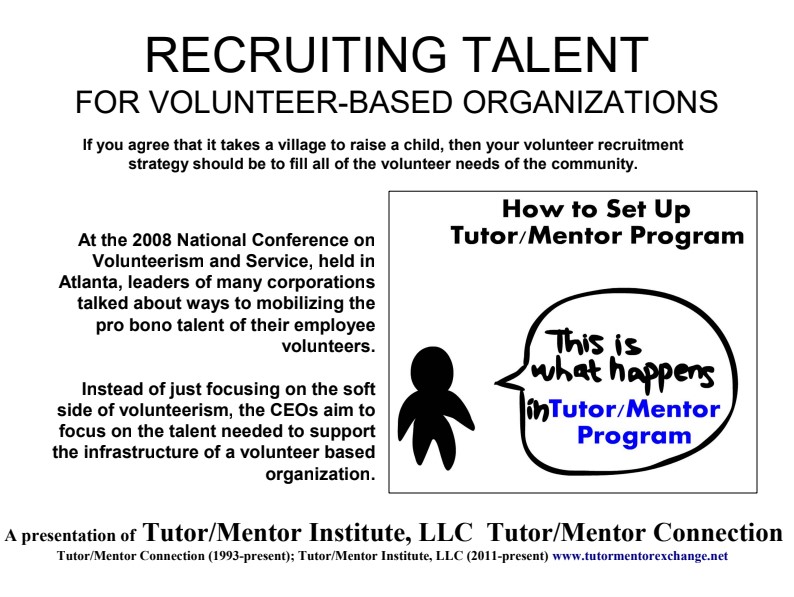
  • Interns with Tutor/Mentor Connection
  • Blogs on T/MC Community Site
  • Making Sense of T/MC (08-09)
  • Network Building - Social Network Analysis

Donate

  • Volunteer at Chicago Area Tutor and/or Mentor Program
  • Join Our Social Media Network
  • Help Fund the Tutor/Mentor Institute, LLC

Tutor/Mentor Connection

  • Mission
  • Vision
  • Strategy
    • Network Building
  • Logic Model
  • Evaluation - OHATS
  • Social Network Analysis
  • Strategic Planning Wikis
  • Awards and Recognition
    • Social Innovation Award
  • Dan Bassill
    • Dan Bassill Interview
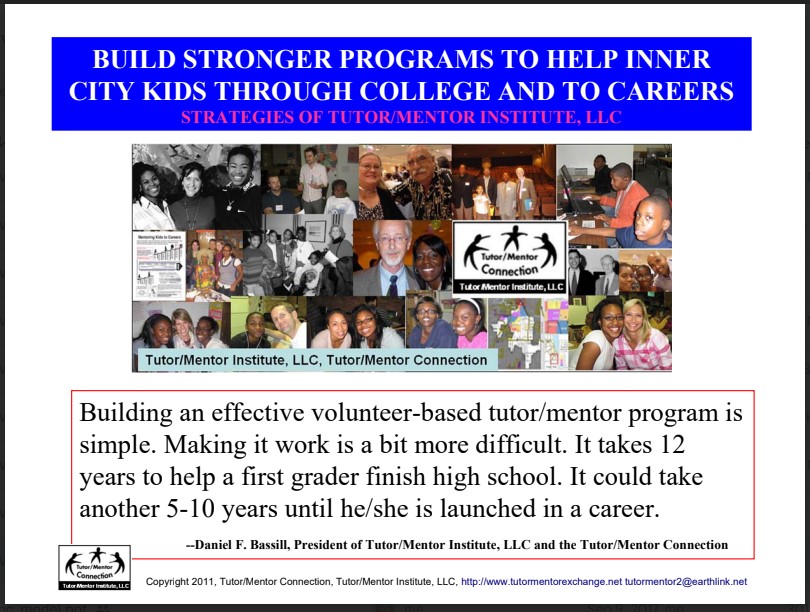
  • 30-Year History with Universities
  • History
  • History - Who has helped T/MC
  • Contact Us
  • In the News
  • Tutor/Mentor Institute Videos
  • Print newsletters of pre2000
Tutor/Mentor Connection (1993-present); Tutor/Mentor Institute, LLC (2011-present)
  • Home
  • Calendar
  • Contact us
  • Video
  • Slide News
  • Library
  • Newsletters
  • Getting Started
  • T/MC Strategy MAP
  • Strategy Presentations
  • Concept Maps
  • For Phone Viewers